European Crane Fly Damage in Seattle Lawns: How to Identify, Check & Respond
European crane flies can damage Seattle-area lawns, but seeing the adults does not mean your lawn is in trouble. The important question is what is happening below the turf. Before treating, look for actual lawn damage, check for crane-fly larvae, and consider the condition of the grass.
Quick Answer
Do not treat a lawn simply because adult crane flies are visible. Adult sightings tell you crane flies are present in the area, not that damaging numbers of larvae are feeding in your lawn.
If the lawn is thinning or declining, sample beneath the turf. Washington State University guidance uses roughly 25 crane-fly larvae per square foot in spring as a point where treatment may be considered, especially when turf is already thin or damaged. Lawn condition matters: a healthy, established lawn can sometimes tolerate substantial larval populations without significant injury.
Pest control and lawn restoration are separate decisions. Controlling larvae does not automatically replace grass that has already been lost.
Not Every Crane Fly Means Lawn Damage
Adult European crane flies are long-legged flies that are often mistaken for oversized mosquitoes. They may be very noticeable around Seattle-area lawns during their adult season, but the adults themselves are not what damages turf.
The damaging stage is the larva. Crane-fly larvae are sometimes called leatherjackets. They live in and near the upper soil and turf layer and feed on grass shoots, crowns and roots. When feeding pressure is high enough, turf can become thin, weak or patchy.
That distinction matters because an evening full of adult crane flies can look alarming even when the lawn underneath is still healthy.
What Crane Fly Damage Can Look Like
Thinning or Weak Turf
Grass can become noticeably thinner as feeding pressure increases, particularly when the lawn is already stressed or weak.
Irregular Damaged Areas
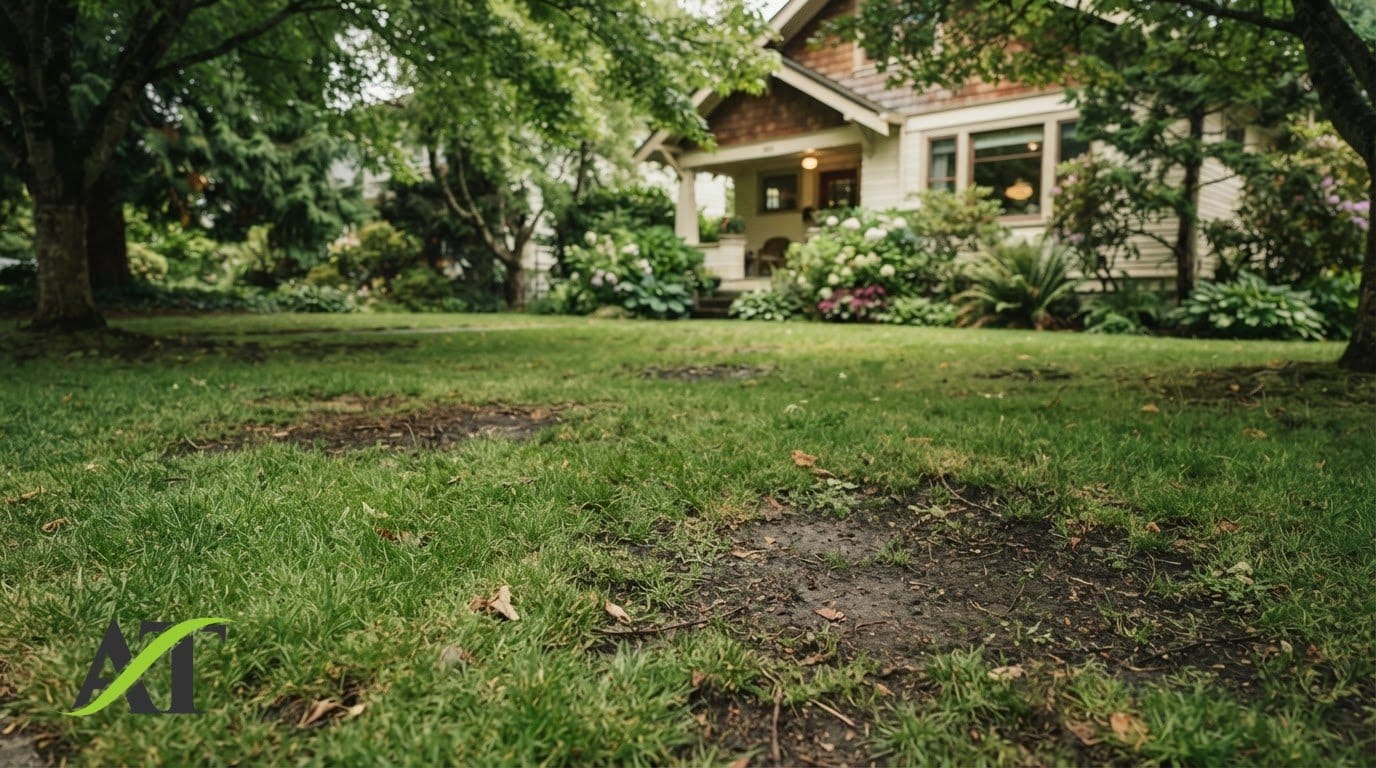
Sections of lawn may lose density or develop declining patches. Appearance alone is not enough to confirm crane flies because several Seattle lawn problems can look similar.
Larvae Beneath the Turf
Crane-fly larvae are generally grayish-brown, legless, worm-like larvae with a tough-looking body. Finding and counting them is more useful than diagnosing by color of the lawn alone.
What about crows, raccoons or other animals?
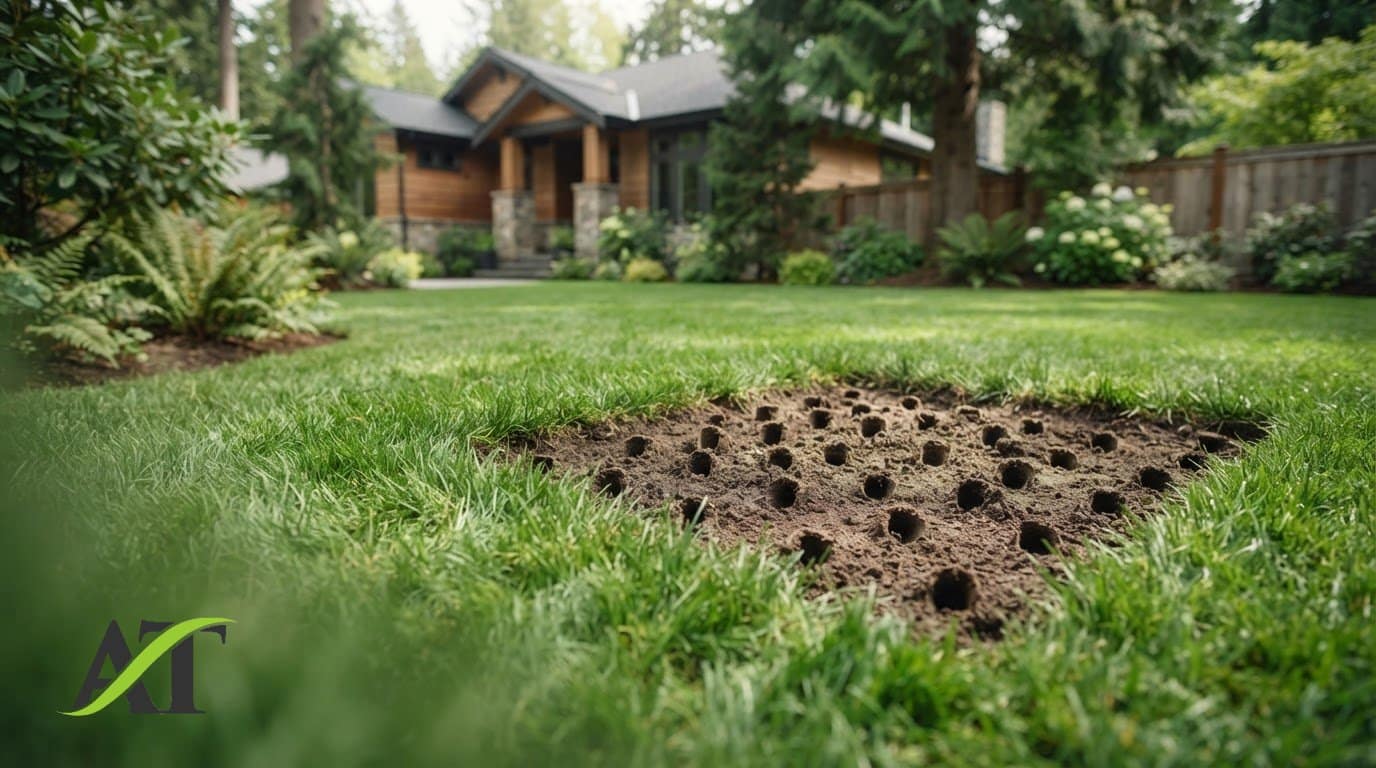
Birds and mammals may dig into turf while looking for larvae and other soil organisms. Their activity can add physical damage on top of insect feeding, but digging by itself does not identify which insect is present.
See our Seattle guide to raccoons, crows, skunks and grub-related lawn digging →
Is It Really Crane Fly Damage?
Brown, thin or disturbed turf has many possible causes in Western Washington. Sampling the soil is usually more informative than relying on appearance alone.
Crane-Fly Larvae
European Chafer Beetles
Summer or Drought Stress
Moss, Shade or Thin Turf
Could it be chafer beetles instead?
European chafer grubs are a separate Seattle-area lawn pest with a different appearance and lifecycle. If you find white, C-shaped grubs rather than gray-brown crane-fly larvae, see our Seattle European chafer beetle guide.
How to Check Your Seattle Lawn for Crane-Fly Larvae
WSU recommends checking the lawn in late winter or early spring rather than making a treatment decision based only on adult crane flies. A simple measured sample gives you a much better picture of population pressure.
Choose Several Areas
Select about three or four representative spots, including areas where the lawn looks thin or suspicious. Avoid basing the decision on one isolated handful of soil.
Inspect a 6 × 6 Inch Section
Each 6-by-6-inch sample equals one-quarter of a square foot. Inspect roughly the top 1 to 2 inches of the turf and soil and count the crane-fly larvae you find.
Convert to Larvae per Square Foot
Multiply the number found in each 6-by-6-inch sample by four. That gives an approximate larvae-per-square-foot count for that sample area.
Use the Number as Context, Not an Automatic Trigger
Current WSU guidance indicates that treatment may be worth considering when spring populations are around 25 larvae per square foot or more and the turf is thin or suffering damage.
That does not mean every lawn at 25 must be treated. Lawn health changes the equation. WSU notes that healthy, well-managed lawns can tolerate surprisingly high populations without significant damage.
When You May Not Need to Treat
If you are mainly seeing adult crane flies, find relatively few larvae, or have a dense lawn that is showing little or no injury, monitoring and maintaining the lawn may be more appropriate than automatically applying an insecticide.
European Crane Fly Seasonal Timeline
Understanding the lifecycle helps explain why adult sightings and visible lawn damage do not always happen at the same time.
Adults Appear
European crane-fly adults typically emerge in late summer into early fall. Eggs are laid in turf and soil and larvae begin developing.
Larvae Continue Feeding
Young crane-fly larvae remain in the lawn through the cool season. Feeding can continue during suitable weather even when obvious lawn damage is not yet visible.
Sample and Watch for Damage
Late winter and early spring are useful times to sample. Feeding injury can become more noticeable as lawns begin active spring growth.
Feeding Winds Down
European crane-fly larval feeding eventually stops as the insects move toward pupation and the next adult cycle. If turf was lost, lawn repair becomes a separate issue.
Crane Fly Control Options
The goal is not to eliminate every crane-fly larva from a lawn. The goal is to prevent meaningful turf loss when populations and lawn condition indicate that damage is likely or already occurring.
Beneficial Nematodes
Insect-eating beneficial nematodes can be used as a biological-control approach. WSU describes them as a tool that can suppress crane-fly populations, not eliminate them.
Application timing, soil moisture, temperature and correct handling matter. Use the directions supplied with the specific nematode product and make sure the species and application instructions are appropriate for the target pest.
Insecticidal Control
If sampling confirms a substantial population and the lawn is being damaged, a labeled insecticide may be considered. Timing is important, and applying a product after the useful treatment window may provide little benefit.
Always read and follow the current product label, including application timing, rates, permitted sites, watering directions, environmental precautions and other restrictions.
Prefer not to handle pest control yourself?
If the infestation appears severe, the diagnosis is uncertain, or you do not want to make a pesticide decision yourself, contact an appropriately qualified pest-management professional. Aerating Thatching Co. focuses on the lawn-repair and restoration side rather than providing crane-fly pesticide applications.
Stewart's Seattle Lawn Note
When a lawn has already lost density, I look at the condition left behind after the pest issue is addressed. Some lawns still have enough grass to recover with relatively light work. Others need new seed and a more deliberate rebuild. The amount of lawn damage should determine the restoration plan, not simply the fact that crane flies were present.
What Crane Fly Control Does Not Fix
Control Addresses the Insect Problem
A successful control decision may reduce further feeding pressure, but it does not instantly replace dead grass, repair wildlife digging, relieve unrelated soil compaction or correct a separate drainage problem.
Restoration Addresses the Lawn Left Behind
If the lawn is thin, bare or physically damaged, new grass may need to be established. Recovery timing should be based on conditions suitable for seed establishment rather than assuming the lawn should be overseeded immediately after pest treatment.
What Should You Do Next?
Crane Fly Control Options When Treatment Is Warranted
These products should not be treated as a yearly shopping list. First identify what is happening in the lawn. Product labels, target pests, application timing and directions can change, so always check the current label before use.

A granular lawn insect-control product for homeowners considering a labeled insecticide approach. Confirm that the current product label includes your target pest and that the application timing fits the crane-fly lifecycle before applying it.
View Current Price on Amazon
This is an animal-repellent product, not a crane-fly larvicide. It may be considered where animal activity is adding physical lawn damage, provided the current label includes the animal and site you are trying to manage.
View Current Price on Amazon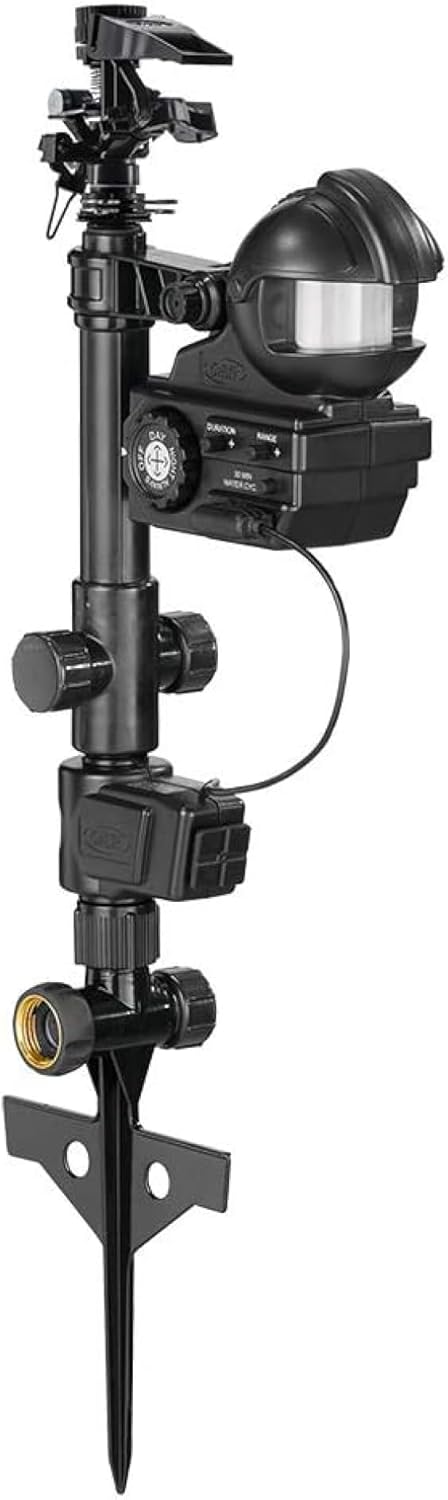
A motion-activated sprinkler can be used as a physical animal-deterrence tool where wildlife is repeatedly disturbing the lawn. It does not control crane-fly larvae beneath the turf.
View Current Price on AmazonImportant: product availability, labeling and permitted uses can change. The current product label controls how and where a pesticide or repellent may legally and safely be used.
A Stronger Lawn Is Part of Crane Fly Defense
A dense, properly maintained lawn is better positioned to tolerate some feeding pressure than a thin, stressed lawn. That does not mean normal lawn care kills crane flies. It means healthy turf can be more resilient when larvae are present.
Maintain Grass Density
Thin turf has less margin for damage. When establishment conditions are appropriate, overseeding can help rebuild density after grass has been lost.
Avoid Unnecessary Stress
Appropriate mowing, watering and fertility help the existing turf remain vigorous. Fertilizer can support healthy growth, but it does not replace missing grass.
Separate Soil Problems From Pest Problems
Compaction, drainage limitations, moss, shade and wet areas can overlap with pest symptoms. Correct those conditions because they affect the lawn, not because they are automatically proof of crane flies.
The Larvae Are Only Half the Problem — What About the Damaged Lawn?
Once the crane-fly issue is under control or no longer active, the next question is how much healthy turf remains. Aerating Thatching Co. focuses on rebuilding the lawn according to its actual condition.
Compaction Is the Main Remaining Problem
If plenty of healthy grass remains but the soil is compacted, Core Aeration may be enough. There is no reason to automatically overseed or choose a larger renovation package if the lawn does not need it.
The Lawn Needs New Grass
If crane-fly feeding or wildlife activity has reduced lawn density, a Seattle Lawn Tune-Up can combine Core Aeration, Premium Overseeding and Starter Fertilizer in one coordinated service.
Heavy Thatch or Moss Also Needs Removal
Dethatching (Power Raking) may make sense when there is a separate layer of thatch, moss or dead surface material that needs to be removed. Crane-fly damage by itself is not a reason to automatically dethatch.
Match the Service to the Lawn
If you are unsure how much restoration is appropriate, describe the damage to Stewart rather than guessing at a package. You can also review the current pricing before requesting a quote.
Stewart's Seattle Lawn Note
After insect or wildlife damage, the first thing I want to know is how much viable grass is still there. If the lawn remains reasonably dense, the repair can be lighter. If large areas are thin or bare, adding new grass becomes much more important. Dethatching (Power Raking) belongs in the plan only when the lawn separately has enough surface buildup to justify it.
What to Do If You Suspect Crane Fly Damage
- Do not treat based on adult crane flies alone.
Adult activity confirms crane flies are around, not that your lawn has a damaging larval population. - Look for actual lawn symptoms.
Check for thinning, weak areas, declining turf or unusual animal digging. - Sample beneath the turf.
Use several measured 6-by-6-inch samples and count crane-fly larvae. - Put the count in context.
About 25 larvae per square foot in spring is a useful WSU benchmark for considering treatment when lawn damage is also present. - If treatment is warranted, choose the control method carefully.
Use current product directions or consult a qualified pest-management professional. - Repair the lawn separately if grass was lost.
Core Aeration, Premium Overseeding or a Lawn Tune-Up may help rebuild the lawn when conditions are suitable for recovery.
Seattle European Crane Fly FAQ
Do crane flies damage Seattle lawns?
Some crane-fly larvae can damage turf by feeding on shoots, crowns and roots. The adult flies themselves are not what causes the lawn injury.
Does seeing adult crane flies mean my lawn is infested?
No. Adult sightings show that crane flies are present in the area, but they do not tell you how many larvae are in your lawn or whether treatment is needed.
How do I check my lawn for crane-fly larvae?
Inspect several 6-by-6-inch sections of turf, roughly 1 to 2 inches deep. Count the larvae in each sample and multiply by four to estimate larvae per square foot.
How many crane-fly larvae are too many?
WSU uses roughly 25 larvae per square foot in spring as a point where treatment may be considered when turf is thin or damaged. Lawn health matters, so the number is not an automatic treatment rule.
When does European crane fly damage show up in Seattle?
Larvae feed through the cool season, with damage often becoming more noticeable in late winter and spring as turf begins active growth.
Do beneficial nematodes eliminate crane-fly larvae?
No. WSU describes insect-eating nematodes as a way to suppress crane-fly populations rather than eliminate them completely.
Should I treat my lawn for crane flies every year?
Not automatically. Sample first and consider whether the lawn is actually being damaged. Established, healthy turf may tolerate crane-fly larvae without requiring treatment.
Why are crows or raccoons digging in my lawn?
They may be searching for larvae, grubs, worms or other food beneath the turf. Digging is a useful clue but does not identify the insect by itself.
Will killing crane-fly larvae repair damaged grass?
No. Pest control and lawn restoration are separate. Thin or bare turf may still need overseeding or other repair after the insect issue is addressed.
When should I overseed after crane-fly damage?
Overseed when temperature, moisture and seasonal conditions provide a reasonable establishment window. The best repair timing is not necessarily the same as the best pest-control timing.
Sources & Further Reading
Technical pest guidance on this page is based primarily on current Washington State University resources. Stewart's notes and Aerating Thatching Co. service recommendations relate to lawn recovery and restoration rather than pesticide application.
Keep Diagnosing Before You Treat
European Chafer Beetles in Seattle
Compare another common root-feeding lawn pest and learn how chafer grubs differ from crane-fly larvae.
Read the guide →What Is Tearing Up My Seattle Lawn?
Understand how raccoons, crows and skunks can add significant physical damage while searching beneath the turf.
See the animal-digging guide →Seattle Lawn Tune-Up
See how Core Aeration, Premium Overseeding and Starter Fertilizer can be combined when a damaged lawn needs greater density.
Explore lawn restoration →Crane Flies Damaged Your Lawn? Let's Rebuild It.
Once the pest issue has been addressed, Aerating Thatching Co. can help determine what the lawn itself needs. A reasonably dense lawn may only need Core Aeration. A thin or patchy lawn may benefit from Premium Overseeding or a Lawn Tune-Up. Dethatching (Power Raking) is recommended only when there is a separate thatch, moss or surface-buildup reason for it.
We serve homeowners in the North Seattle area, North King County and South Snohomish County. Review pricing first or tell Stewart what happened to the lawn and he can recommend an appropriate restoration approach.