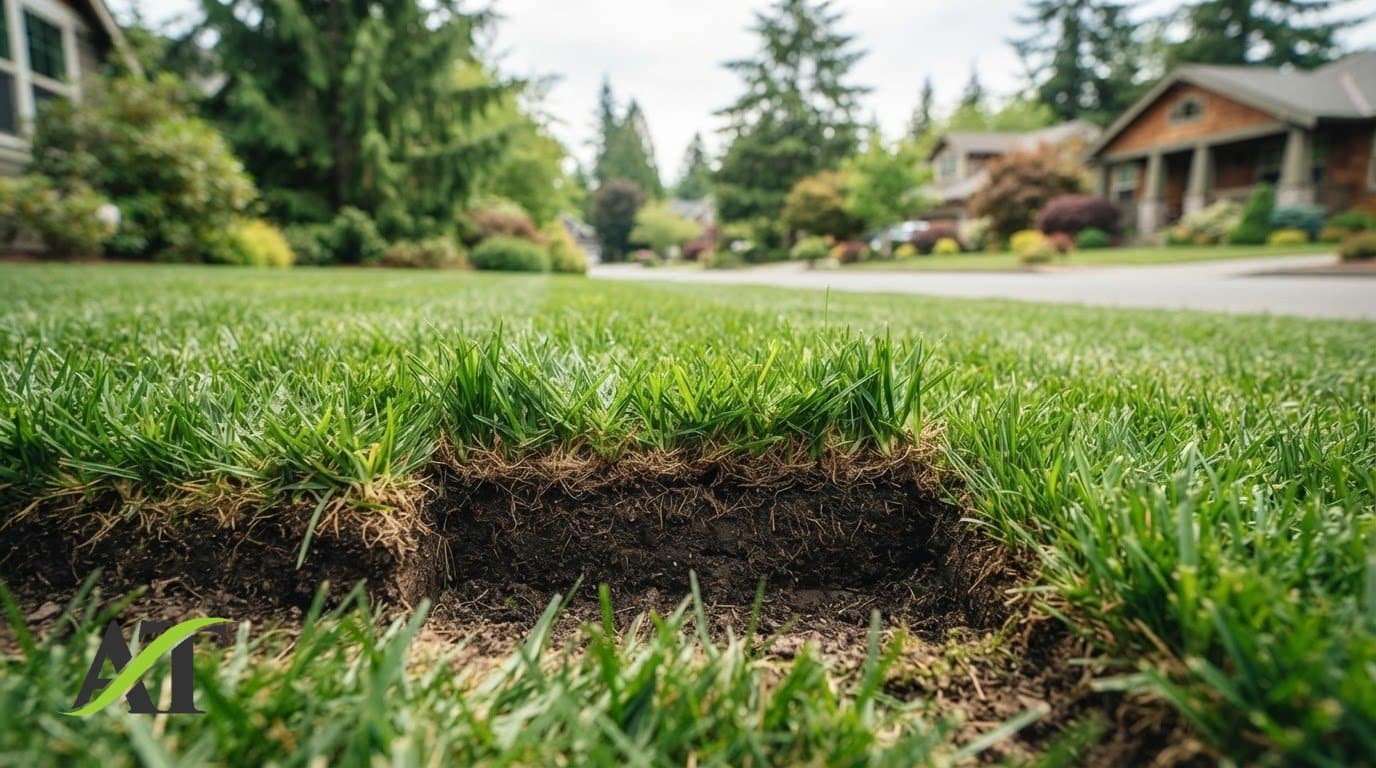
June Lawn Watering Tips for the North Seattle Area
June is a transition month for lawns throughout the North Seattle area. Spring moisture may still be lingering in some soils while sunny, exposed lawns can already be drying quickly. The best approach is not to water simply because the calendar says it is time.
Check the lawn, check the soil, account for recent rain, and water according to what the root zone actually needs.
Should You Water Your Lawn in June?
Don’t water an established North Seattle–area lawn just because it is “watering day.”
First check the soil below the grass surface. If the root zone is still adequately moist, wait. If it is becoming dry and the grass is beginning to show moisture stress, irrigate enough to move useful moisture into the root zone without creating unnecessary runoff, puddling, or prolonged soggy conditions.
June can include both lingering spring moisture and the beginning of summer dryness, so the right schedule can change from week to week.
Your 4-Step June Watering Decision
Has It Rained?
Consider recent meaningful rainfall before allowing the next automatic sprinkler cycle to run.
Check the Soil
Look below the grass surface. A dry surface can still have useful moisture deeper in the root zone.
Watch How Water Soaks In
If water quickly runs downhill or onto pavement, longer runtime is not automatically helping.
Water Only as Needed
Adjust irrigation to the actual lawn, soil, recent weather, and sprinkler coverage.
Important exception: newly seeded grass
Fresh seed and young seedlings need dependable establishment moisture and should not be managed the same way as mature established turf. See the New Grass Is Different section below.
What June Weather Means for a North Seattle–Area Lawn
June is often when lawns begin shifting away from dependable spring moisture toward the drier conditions of summer. That transition does not happen at the same speed on every property.
Sunny & Exposed
Open south- and west-facing lawn areas may begin drying noticeably faster as days lengthen.
Shaded Areas
Lawns under trees, beside buildings, or on cooler exposures may retain moisture much longer.
Slopes
Water may move downhill before enough has soaked into the soil where grass roots can use it.
Soil Differences
Soil texture, organic matter, compaction, drainage, and previous drying can all change water behavior.
Local conditions matter more than the city name
A sunny lawn in Mill Creek or Lynnwood may dry much faster than a shaded lawn in Shoreline or Lake Forest Park. The same variation occurs throughout Kenmore, Bothell, Mountlake Terrace, Edmonds, and nearby North Seattle–area communities. Sun exposure, tree cover, slope, soil, drainage, and irrigation coverage determine watering needs property by property.
Check the Soil Before You Water
The Screwdriver Test
A screwdriver, soil probe, or small hand trowel can provide a useful field check before you irrigate.
- Choose a representative part of the lawn.
- Push a screwdriver or probe into the soil.
- Check below the surface rather than judging only by dry grass blades or the top crust of soil.
- Compare sunny areas with shaded or historically wet areas.
The screwdriver test is a practical indicator, not a precision moisture measurement. Its value is helping you look below the surface before automatically turning on the sprinklers.
What the Grass Can Tell You
Early moisture-stress clues in turf you are trying to keep actively green can include:
- Footprints remain visible instead of springing back readily.
- The lawn loses its normal sheen.
- Grass shifts toward a dull blue-green or gray-green appearance.
- Individual blades begin folding or curling.
- Sunny portions show stress before shaded areas.
These signs should be considered together with soil moisture. Appearance alone does not tell the whole story.
Four Conditions to Recognize Before Adjusting Irrigation
Soil Still Moist
What to do: Wait.
More water is not automatically better when useful moisture is already present.
Dry Below the Surface
What to do: Consider watering.
Especially when the grass is also beginning to show early moisture stress.
Water Runs Off
What to do: Slow down the application.
Use shorter cycles and investigate slope, application rate, or compaction.
New Seed
What to do: Follow establishment watering.
Fresh seed needs dependable surface moisture and should not follow mature-lawn rules.
What You Observe, What It May Mean, and What to Do Next
| What You Observe | What It May Mean | What to Do Next |
|---|---|---|
| Soil below the surface is still moist | The root zone may already have enough available moisture | Wait and check again later rather than watering by calendar |
| Root-zone soil is becoming dry and grass shows early stress | The established lawn may be ready for irrigation | Water enough to move moisture into the active root zone without unnecessary runoff |
| Water begins running downhill or onto pavement | Application is exceeding the soil's current infiltration rate | Use cycle-and-soak and investigate slope, sprinkler output, or compaction |
| Soil remains soggy well after rain or irrigation | The area may be receiving more water than it can use or drain | Delay irrigation and investigate drainage, application amount, and existing moisture |
| One area browns while nearby lawn remains green | Coverage, sun exposure, roots, slope, or soil differences may be localized | Compare sprinkler coverage and soil moisture before increasing water everywhere |
| Grass was recently seeded | Young grass is still establishing shallow roots | Follow new-seed after-care and maintain dependable establishment moisture |
How Often Should You Water an Established Lawn in June?
There is no single schedule that works equally well for every North Seattle–area lawn. Established turf generally benefits from watering that reaches the active root zone while allowing appropriate drying between irrigation events, rather than receiving automatic shallow sprinklings every day.
Water the Soil, Not the Clock
Twenty minutes can deliver very different amounts depending on sprinkler type, spacing, pressure, nozzle design, and wind.
Allow for Rain
Meaningful rainfall should change your irrigation schedule. Check moisture before allowing the next programmed cycle to run.
Watch the Lawn
Use grass appearance and root-zone moisture together rather than relying on a preset number of watering days.
How long should I run my sprinklers?
There is no universal number of minutes.
Sprinkler output, coverage, slope, soil absorption, recent rainfall, and current lawn conditions determine how useful a given runtime will be. Measure what your system actually applies instead of copying someone else's runtime.
Let Natural Rainfall Change the Plan
June weather can vary considerably. A meaningful rain event may delay or eliminate the need for the next irrigation cycle.
Do not assume that every rain event supplied enough moisture—but do not ignore it either. Check the actual soil before deciding what comes next.
Don’t Let the Controller Make the Decision
An automatic controller is useful, but a schedule programmed for hotter weather can waste water when June turns cooler or wetter.
Adjust, pause, or skip cycles when rainfall and soil moisture show that irrigation is not currently needed.
What Is the Best Time of Day to Water?
Preferred: Early Morning
Early morning is generally the best window because temperatures are cooler, evaporation losses are lower, and grass foliage can dry as the day progresses.
Avoid Making Midday the Routine
Hot, windy daytime conditions can make irrigation less efficient. Routine late-night leaf wetness may also keep turf wet for longer periods than necessary.
Timing matters, but it does not replace checking whether the lawn actually needs water.
Before Watering More, Check Your Sprinkler Coverage
When one area turns dry while another stays green, increasing irrigation across the entire lawn may create new problems. First confirm whether the dry section is receiving the same amount of water.
Place Containers
Put several equal-sized, straight-sided containers around one irrigation zone.
Run the Zone
Run the sprinklers for a known amount of time under normal operating conditions.
Compare the Results
Compare the depth collected in each container. Large differences can reveal uneven coverage.
What the catch-can test tells you
It helps answer two practical questions:
- Is this sprinkler zone covering the lawn evenly?
- How much water is the zone actually delivering during a known runtime?
You do not need a complicated formula to make the test useful. If one container receives much less than another, correct the coverage problem before using the driest spot to determine the schedule for the entire lawn.
What Should You Do When Water Runs Off Instead of Soaking In?
A long sprinkler cycle is not automatically “deep watering” if much of the water leaves the lawn. Slopes, compacted areas, and slow-absorbing soils may begin shedding irrigation before enough reaches the root zone.
Water
Apply water until the soil has received a useful amount but before substantial runoff develops.
Pause
Stop and give the moisture already applied time to move farther into the soil.
Resume if Needed
Apply another shorter cycle if additional water is still needed.
The goal is infiltration, not runtime
This cycle-and-soak approach can help on slopes or soil that accepts water slowly. If infiltration remains poor even with sensible application rates, investigate whether compaction or another soil condition is contributing.
Soil Conditions Change How a Lawn Uses Water
Soil Texture
Different textures hold and release moisture at different rates.
Organic Matter
Soil condition can affect both water-holding capacity and root development.
Compaction
Dense soil can restrict rooting and make useful water infiltration more difficult.
Previous Drying
Some very dry soil becomes harder to wet evenly after it has dried substantially.
This is why copying a neighbor’s sprinkler schedule is rarely the best strategy. Even adjacent lawns may have different sun exposure, rooting depth, irrigation coverage, compaction, and soil conditions.
More Water Isn’t Always Better
Soil that stays saturated for extended periods has less air available to the roots. Avoid adding more irrigation when the lawn is already adequately moist.
Stronger clues
- Soil remains soggy well after irrigation or rain.
- Water stands or puddles instead of infiltrating.
- Significant runoff starts quickly.
- The system waters again while the root zone is still wet.
Possible clues — not proof by themselves
- Mushrooms appearing during moist weather.
- Moss thriving in damp or shaded areas.
- Very soft or persistently wet soil.
Mushrooms and moss can have several causes. Neither one automatically proves that irrigation is excessive.
Established Lawns and Newly Seeded Lawns Need Different Watering
Established Lawn
Mature turf is generally managed by monitoring moisture deeper in the active root zone and irrigating when conditions indicate it is needed.
- Check root-zone moisture.
- Account for rainfall.
- Avoid automatic daily shallow watering.
- Watch for runoff and saturation.
New Seed / Young Grass
Freshly seeded areas need dependable moisture during germination and early establishment. The seedbed should not repeatedly dry out.
- Maintain appropriate establishment moisture.
- Avoid allowing the seeded surface to repeatedly dry.
- Reduce watering frequency gradually as roots develop.
- Follow the after-care instructions for the service performed.
Keeping the Lawn Green vs. Allowing Summer Dormancy
Established cool-season grass can respond to prolonged summer dryness by slowing growth and losing green color. A lawn that is entering summer dormancy should not automatically be treated as though every brown blade requires dramatically more irrigation.
Maintain Active Green Growth
If your goal is to keep the lawn green and actively growing, monitor soil moisture and irrigate as needed before significant drought stress develops.
- Monitor the root zone.
- Correct uneven irrigation coverage.
- Account for rainfall.
- Avoid chronic saturation.
Allow Summer Dormancy
Some homeowners choose to let established cool-season turf lose color during extended dry periods rather than maintaining active green growth.
Dormant-looking turf and dead turf are not automatically the same thing. During prolonged severe dryness, regional guidance still calls for appropriate survival moisture rather than assuming the lawn can remain completely dry indefinitely.
Watering and Mowing Work Together
Good irrigation cannot fully compensate for stressful mowing practices during dry weather.
Avoid Scalping
Do not repeatedly cut the lawn extremely short simply to reduce mowing frequency.
Use a Sharp Blade
Clean cuts reduce unnecessary tearing and stress to grass blades.
Avoid Removing Too Much at Once
Heavy one-time cutting can add stress just as summer conditions become more demanding.
Why One Part of the Lawn Can Stay Dry Even When You’re Watering
Uneven Coverage
A sprinkler may miss an edge, have poor overlap, or be partially obstructed.
More Sun & Heat
Areas beside pavement, walls, or open exposures can dry faster than shaded turf.
Tree-Root Competition
Established trees and shrubs can compete strongly with nearby turf for moisture.
Slopes
Water may move downhill before enough moisture can infiltrate.
Compacted Soil
Compaction can restrict rooting and make useful water penetration more difficult.
Difficult-to-Wet Soil
Some dry areas accept and distribute water less evenly than neighboring soil.
When Can Core Aeration Help Water Penetration?
When soil compaction is restricting infiltration, Core Aeration can create openings in the compacted root zone and improve the movement of water and air into the soil.
Core Aeration is not a universal fix for every dry spot. It does not correct poor sprinkler coverage, grading, tree-root competition, or normal summer dryness.
When a Soil Wetting Agent May Help
A soil wetting agent can be useful where dry soil has become difficult to wet evenly and irrigation repeatedly fails to distribute moisture through the area as expected.
It does not replace adequate irrigation, sprinkler correction, drainage work, or Core Aeration where compaction is the actual problem.
“The important thing is not assuming every lawn needs the same amount of water. A sunny exposed section can be drying while a shaded part of the same lawn is still holding plenty of moisture. Check what the lawn and soil are actually doing before adding more water.”
Practical lawn-care perspective from Aerating Thatching Co. The amount and frequency of irrigation still depend on the individual property and weather conditions.
Common June Lawn Watering Mistakes
Watering by Calendar Alone
June weather changes. A fixed schedule can easily become too much or too little.
Frequent Shallow Watering
Routine light sprinklings may fail to supply useful moisture deeper in the established lawn's root zone.
Ignoring Rain
Natural rainfall should influence whether the next automatic irrigation cycle is needed.
Watering Already-Wet Soil
More irrigation is unnecessary when the root zone is already adequately moist.
Using One Runtime Everywhere
Different sprinkler zones, slopes, soils, and exposures may need different treatment.
Ignoring Runoff
Water running into the street or downhill is not becoming useful root-zone moisture.
Treating New Seed Like Mature Turf
Newly seeded areas need dependable establishment moisture and a separate watering approach.
June Lawn Watering Checklist
- Check soil moisture before turning on irrigation.
- Account for meaningful recent rainfall.
- For established turf, water the root zone rather than sprinkling lightly by habit.
- Use early morning as the preferred watering window.
- Stop and adjust when significant runoff develops.
- Check sprinkler coverage with straight-sided containers.
- Treat newly seeded grass differently from established turf.
- Adjust the controller as weather changes instead of leaving it on autopilot.
Check Current Local Watering Guidance
Water-use rules and conservation requests can change. If your local utility or municipality has current watering restrictions or drought guidance in effect, follow those current requirements rather than relying on an evergreen article for temporary rules.
June Lawn Watering FAQ for the North Seattle Area
How often should I water my lawn in June?
Do not rely on one fixed June schedule. Check root-zone moisture, grass condition, rainfall, sun exposure, soil, and sprinkler coverage. Water an established lawn when conditions show that it actually needs moisture.
How can I tell whether my lawn actually needs water?
Look for early stress clues such as footprints remaining visible, dull blue-green color, or curling blades, and then check the soil below the surface. If the root zone is still adequately moist, wait.
What is the best time of day to water?
Early morning is generally preferred. Cooler temperatures and typically lower evaporation make it an efficient window, and the grass has time to dry as the day progresses.
How long should I run my sprinklers?
There is no universal number of minutes. Sprinkler output, coverage, soil absorption, slope, wind, and lawn conditions all affect how useful a given runtime will be. Use straight-sided catch containers to see what your system is actually delivering.
What should I do if sprinkler water runs off before soaking in?
Stop the cycle and give the applied moisture time to soak in, then resume with another shorter cycle if additional water is needed. This cycle-and-soak method can be particularly useful on slopes or slower-absorbing soil.
Why is one part of my lawn brown while another part stays green?
Uneven sprinkler coverage, sun exposure, slopes, tree-root competition, compaction, and soil differences can all cause localized dry areas. Compare irrigation coverage and soil moisture before increasing water across the entire lawn.
Does Core Aeration help water penetrate the soil?
It can when compaction is restricting infiltration. Core Aeration creates openings in compacted soil, but it will not correct every cause of dryness, including poor sprinkler coverage, slopes, or normal summer weather.
Does newly seeded grass need a different watering schedule?
Yes. New seed needs dependable surface moisture during germination and early establishment, while established turf is normally managed by monitoring moisture deeper in the root zone.
Not Sure Why Your Lawn Isn’t Taking Up Water?
If the same areas stay dry despite reasonable watering, tell Stewart what you are seeing. The next step may simply be correcting sprinkler coverage or watering habits—or there may be a compaction or water-penetration issue worth addressing.
The goal is to identify the problem before choosing a service.
Pacific Northwest Lawn-Watering Resources
These regional resources were used for information in this article, including soil-moisture checks, irrigation timing, sprinkler-output measurement, summer dormancy, runoff management, and lawn watering practices.