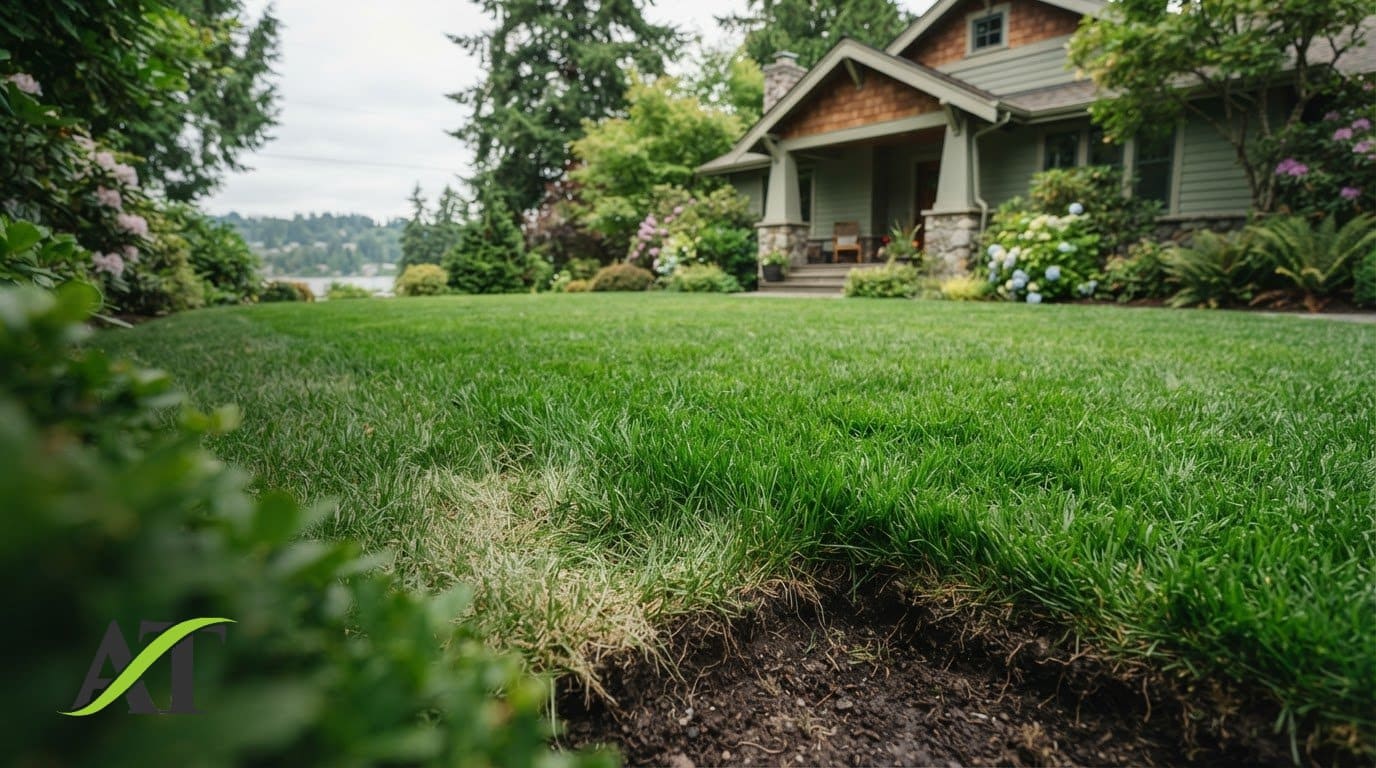
Why does your Seattle backyard feel more like a concrete slab than a lawn every time the summer sun hits? If you’re tired of watching rainwater pool on the surface while moss chokes out your thin grass, you’re dealing with the reality of our local geology. Most homeowners here struggle with dense Vashon Till and Lawton Clay that compacts into an impenetrable barrier. Effective clay soil aeration Seattle relies on physical core removal to let your lawn finally breathe again.
We understand the frustration of a yard that repels water instead of soaking it in. This guide shows you how to transform that “Seattle sponge” into a thriving, green landscape using professional Core Aeration and restorative treatments. You’ll learn the difference between a standard Lawn Tune-Up, which consists of Core Aeration, Overseeding, and Fertilizing, and the comprehensive Full Meal Deal that adds Power Raking (Dethatching) to the process. We also explain why tracking soil temperatures between 55°F and 75°F is the key to helping your Overseeding establish. It’s time to stop fighting your soil and start fixing it.
Key Takeaways
- Understand how Seattle’s glacial till and clay create “hardpan” conditions and learn to spot the signs of compaction before they ruin your grass.
- Discover why clay soil aeration Seattle homeowners rely on requires mechanical core removal to physically fracture dense subsoil and improve drainage.
- Learn why tracking soil temperatures between 55°F and 75°F is more important than checking the weather forecast for successful Overseeding.
- Learn to choose between a Lawn Tune-Up and the Full Meal Deal, which consists of Power Raking (Dethatching), Core Aeration, Overseeding, and Fertilizing.
The Seattle Clay Challenge: Why Your Lawn Feels Like Concrete
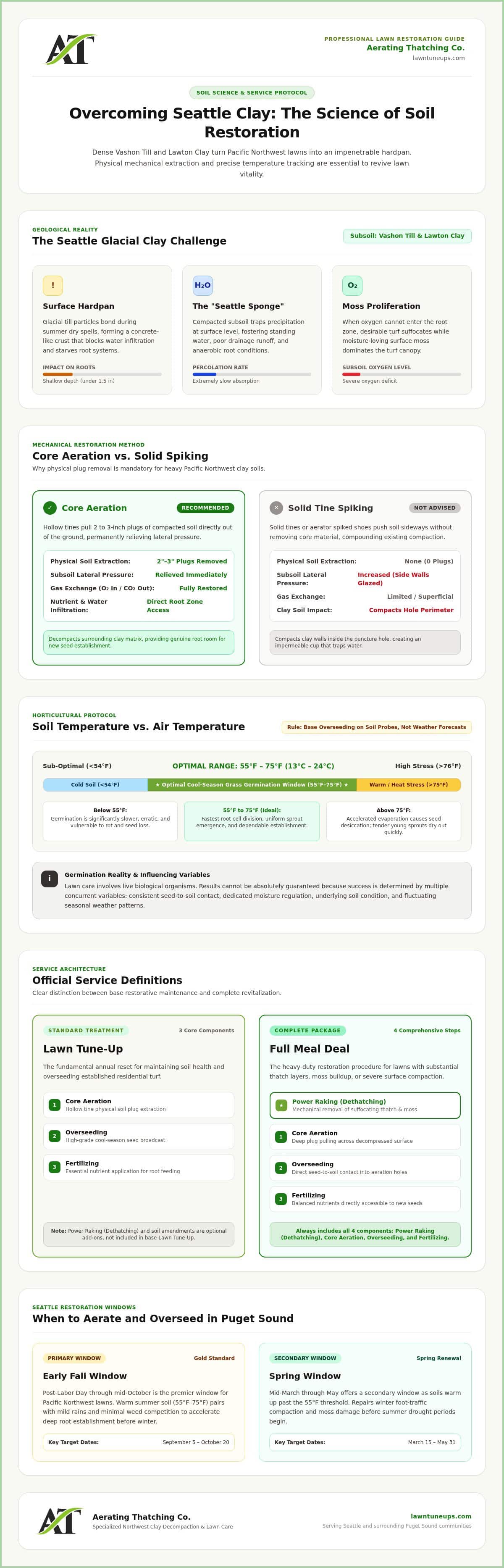
Seattle’s soil is a product of the Vashon Stade of the Fraser Glaciation. Approximately 17,000 years ago, this event left behind dense deposits of Lawton Clay and Vashon Till. These microscopic particles bind together under the weight of foot traffic and heavy rains. When the soil dries out during our summer drought spells, it transforms into a nearly impenetrable hardpan. This geological reality is why so many yards in North Seattle feel like a concrete slab by late August. It’s a physical problem that requires a physical solution.
Fracturing this barrier requires mechanical core aeration to restore vital gas exchange and moisture infiltration. By removing physical plugs of soil, we create the necessary space for your lawn to breathe and recover. This process is the foundation of effective clay soil aeration Seattle services. It allows nutrients to reach the root zone instead of washing away into the street; otherwise, your fertilizer simply sits on top of the soil.
Signs Your North Seattle Lawn is Compacted
You don’t need a degree in geology to spot compaction. Look for these red flags on your property:
- Water pools on the surface after a light drizzle or runs off toward the sidewalk.
- Grass looks thin or patchy, with bare soil that feels hard to the touch.
- Your lawn browns quickly in the summer because shallow roots can’t reach deeper moisture.
Why Moss Thrives in Compacted Clay
Moss is an opportunist that loves the “Seattle sponge” effect. Compacted clay holds moisture at the surface while starving grass roots of oxygen. This creates an anaerobic environment where grass fails and moss thrives. Professional clay soil aeration Seattle treatments change this environment. By improving drainage and airflow, we give your grass the edge it needs to outcompete moss for space. Mechanical restoration is the first step toward a healthy, moss-free lawn.
How Core Aeration Works to Restore Clay Soil
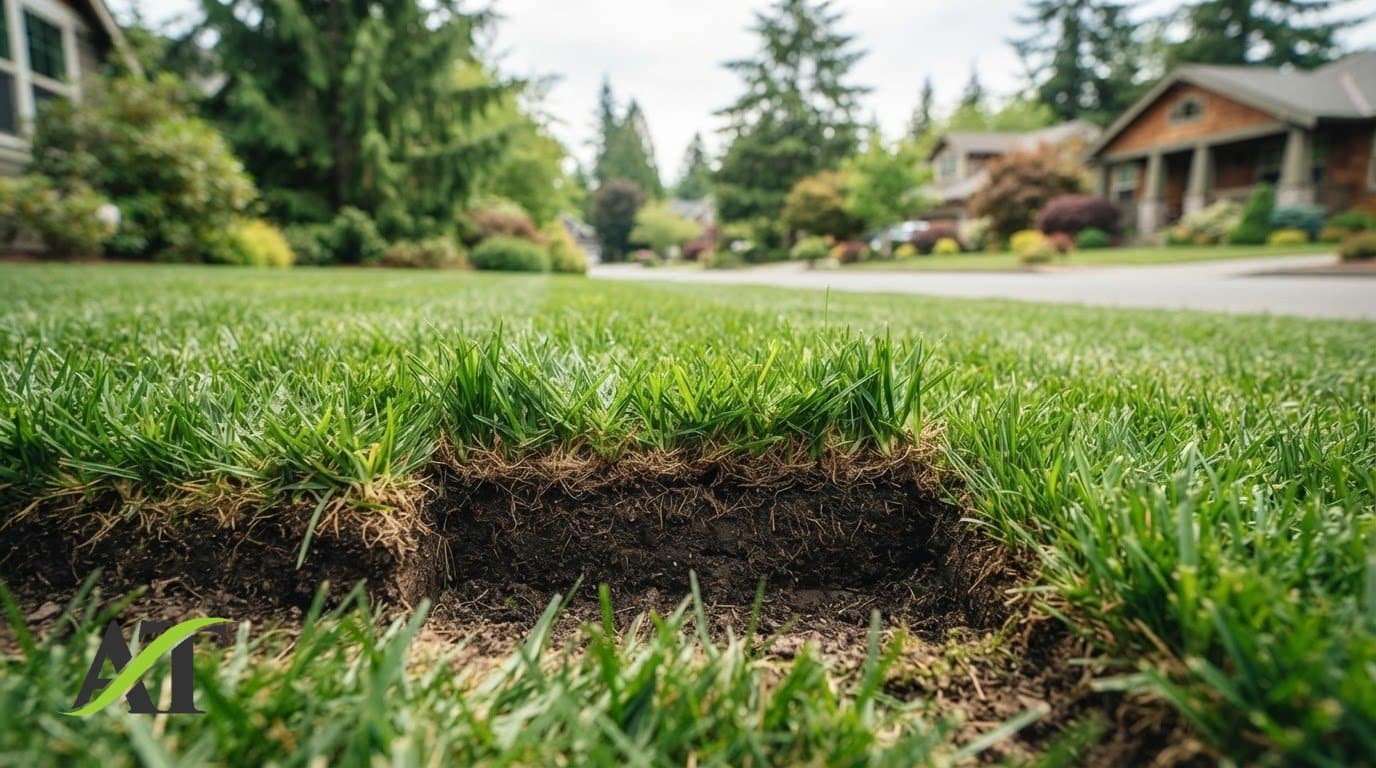
Seattle’s heavy clay demands more than a surface-level treatment. Mechanical Core Aeration works by using hollow tines to pull physical cylinders of soil, called plugs, out of the ground. These plugs are typically two to three inches deep. By physically removing this mass, we create immediate relief for the surrounding soil. It’s the only way to break the hardpan cycle that suffocates local lawns and prevents healthy growth.
When you remove these cores, you initiate a process called gas exchange. Compacted clay is anaerobic, meaning it lacks the oxygen necessary for root survival. Removing soil allows oxygen to enter the root zone while letting trapped carbon dioxide escape. This allows roots to breathe and expand into the newly created space. Without this mechanical intervention, your lawn stays trapped in a state of stunted growth. If you’re ready to fix your soil structure, you can get a free estimate for your property today.
Core Aeration vs. Spiking: Why Plugs Matter
Many homeowners try spiking with solid tines or aerator shoes. In our region, this often does more harm than good. Spiking doesn’t remove soil; it simply pushes it to the side. In dense clay, this further compresses the walls of the hole and increases lateral pressure. Professional clay soil aeration Seattle requires removing the core entirely. Aerating Thatching Co. uses specialized equipment designed to pull deep, clean cores that provide lasting relief from compaction.
The Long-Term Benefits for Turf Health
A properly aerated lawn is far more resilient. Deeper root penetration means your grass can access moisture buried deep in the subsoil during dry July and August weeks. This significantly improves drought resistance. Additionally, Core Aeration enhances the efficacy of Organic Fertilizing. Nutrients can drop directly into the open holes, reaching the roots where they’re needed most rather than washing away during the next heavy rainstorm.
Timing and Temperature: When to Aerate in Seattle
Seattle’s maritime climate provides two primary windows for lawn restoration. Early fall, starting after Labor Day through mid-October, is the gold standard. Spring, from mid-March through May, is the secondary window. However, the calendar isn’t your only guide. Successful clay soil aeration Seattle projects depend more on what’s happening underground than the date on the wall.
Air temperature is a deceptive metric for lawn care. It fluctuates wildly while soil temperature remains stable. For cool-season grass seed, the optimal soil temperature range is 55°F–75°F (13°C–24°C). This is the window where seeds have the best chance to establish. Seeding too early or too late often leads to wasted effort.
The 55°F–75°F Rule for Grass Seed Germination
Soil temperature dictates the speed and success of your Overseeding. If you seed when the ground is too cold, the seed stays dormant and risks rotting. Early spring frost or late fall cold snaps can significantly delay growth. While germination can occur outside the 55°F–75°F range, it will be slower, less consistent, and produce less reliable results. We don’t offer absolute guarantees on germination because moisture, weather, and seed-to-soil contact all play a role.
Preparing Your Yard for Core Aeration
Proper preparation ensures deep cores in stubborn clay. Water your lawn deeply 24 to 48 hours before your service. Moist soil allows the tines to penetrate deeper into the clay hardpan. You must also mark all sprinkler heads and shallow cables. Our machines are powerful; marking these hazards prevents damage during the clay soil aeration Seattle process. Clear the lawn of toys, furniture, and debris before we arrive.
Beyond Aeration: The Lawn Tune-Up and Full Meal Deal
While Core Aeration solves the physical compaction of our local hardpan, it’s only the first phase of a true restoration. Seattle yards often suffer from thinning grass and nutrient depletion alongside compaction. To build a resilient lawn, you need to introduce new genetics and high-quality nutrients. This is why we bundle our services into logical, results-driven packages. Effective clay soil aeration Seattle homeowners trust is most successful when paired with strategic seeding and feeding.
The Components of a Professional Lawn Tune-Up
The Lawn Tune-Up is our essential restoration package. It consists of three specific components: Core Aeration, Overseeding, and Fertilizing. We start by relieving compaction to create space. Then, we perform Overseeding using a premium 60/40 Sun & Shade mix. This blend is specifically selected for the Pacific Northwest’s unique light conditions. Finally, we apply a microbial-boosting organic fertilizer to kickstart growth. This combination ensures that as the soil temperature stays between 55°F and 75°F, your new grass has the best possible environment to establish.
When to Choose the Full Meal Deal
Some lawns face an additional barrier: a thick layer of dead organic matter known as thatch. If your grass feels spongy or you can see a mat of brown material above the soil line, you need the Full Meal Deal. This package includes exactly four services: Power Raking (Dethatching), Core Aeration, Overseeding, and Fertilizing. Power Raking (Dethatching) removes that debris so the seed can actually touch the dirt. Without this step, your new seed might get trapped in the thatch and never germinate. You can find more details on the Seattle Lawn Tune-Up page to see which option fits your yard’s current condition.
Take Control of Your Seattle Soil Today
Restoring a lawn in the Puget Sound region requires a plan that respects our local geology. You now understand why mechanical Core Aeration is the only way to fracture dense clay and why tracking soil temperature between 55°F and 75°F is critical for seed success. Whether you need a standard Lawn Tune-Up or the deep cleaning of a Full Meal Deal, the focus remains on physical soil relief.
We’ve been serving Western Washington since 2004. As a local, owner-operated business, we bring the professional-grade Core Aeration equipment and expertise needed to handle the toughest hardpan. We don’t offer absolute guarantees on germination, but we do promise a no-nonsense approach to clay soil aeration Seattle homeowners can rely on for real results.
Your yard doesn’t have to stay a “Seattle sponge” every winter. With the right timing and mechanical restoration, a thick, healthy lawn is finally within reach.
Frequently Asked Questions
Is core aeration necessary for all Seattle lawns?
Core Aeration is essential for nearly every lawn in the North Seattle area due to our local soil geology. Our native Vashon Till and Lawton Clay compact easily under foot traffic and heavy rains. This process creates the necessary channels for oxygen and water to reach the roots. Without regular clay soil aeration Seattle yards often become waterlogged or turn into hardpan; this prevents healthy grass growth and encourages moss.
Will core aeration damage my underground sprinkler system?
Our equipment is heavy and designed to pull deep plugs, so underground hazards must be marked. We require homeowners in Shoreline and Edmonds to flag all sprinkler heads, shallow cables, and valve boxes before we arrive. While the machines are powerful, clear marking prevents damage during the restoration process. Proper preparation allows us to focus on relieving compaction without risking your property’s infrastructure or irrigation system.
How long does it take for grass seed to germinate after a Lawn Tune-Up?
Germination depends primarily on soil temperature rather than air temperature. For the cool-season blends we use in our Lawn Tune-Up, the optimal soil temperature range is 55°F–75°F (13°C–24°C). You typically see growth within 10 to 21 days under these conditions. We don’t offer absolute guarantees on results because moisture, weather, and soil contact vary. Germination will be slower and less consistent if the ground remains too cold.
Do I need to pick up the soil plugs left on my lawn after aeration?
You should leave the plugs on the lawn to decompose naturally. These cores are rich in microbes and nutrients that benefit your soil as they break down over one to two weeks. As they dissolve, they help fill the holes with loose material that isn’t as compacted as the original clay. This natural recycling is a key part of clay soil aeration Seattle homeowners use to improve their lawn’s long-term health.
Can I aerate my lawn if I have a heavy moss problem?
Aeration is the best first step for a mossy yard. Moss thrives in the compacted, poorly drained clay common in Bothell and Lynnwood. By performing Core Aeration, we improve the drainage that moss hates. If the moss layer is thick, we recommend the Full Meal Deal. This package includes exactly four services: Power Raking (Dethatching), Core Aeration, Overseeding, and Fertilizing. This ensures the seed reaches the soil.
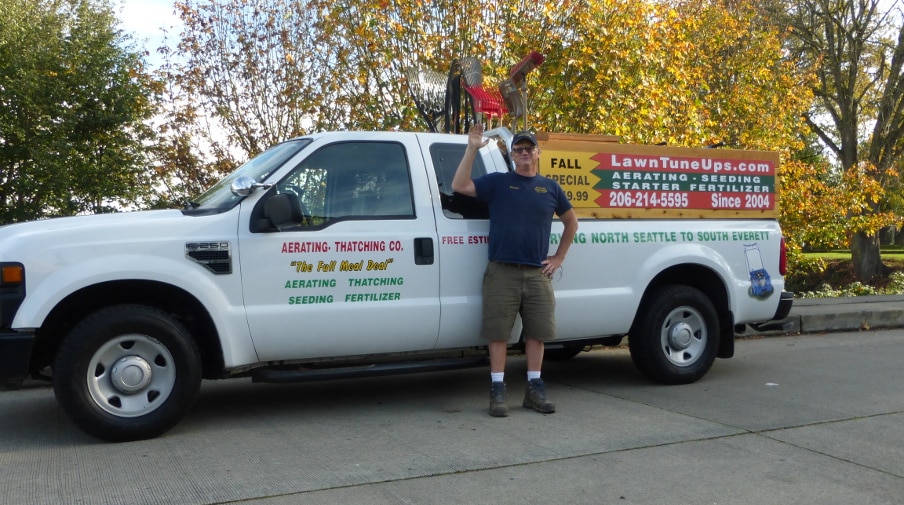
Article by
Stewart Armour
Stewart Armour is an independent lawn restoration expert, educator, and owner of Aerating Thatching Co., serving the greater Seattle area since 2004. With more than two decades of professional experience restoring Western Washington lawns, Stewart specializes in diagnosing lawn problems, improving soil health, and developing long-term lawn renovation strategies. His education includes turf management studies, advanced golf course turf training, and continuing education through Wilbur-Ellis University, State Turf Facilities, Soil First Academy, and Golf Course Applied Turf Physiology. Every article published on LawnTuneUps.com is grounded in practical field experience, current turf science, and a commitment to helping homeowners understand the why behind every recommendation—not just what to do.
Stewart has personally evaluated thousands of residential lawns throughout the Seattle area and remains committed to helping homeowners understand the science behind growing healthier, more resilient lawns.