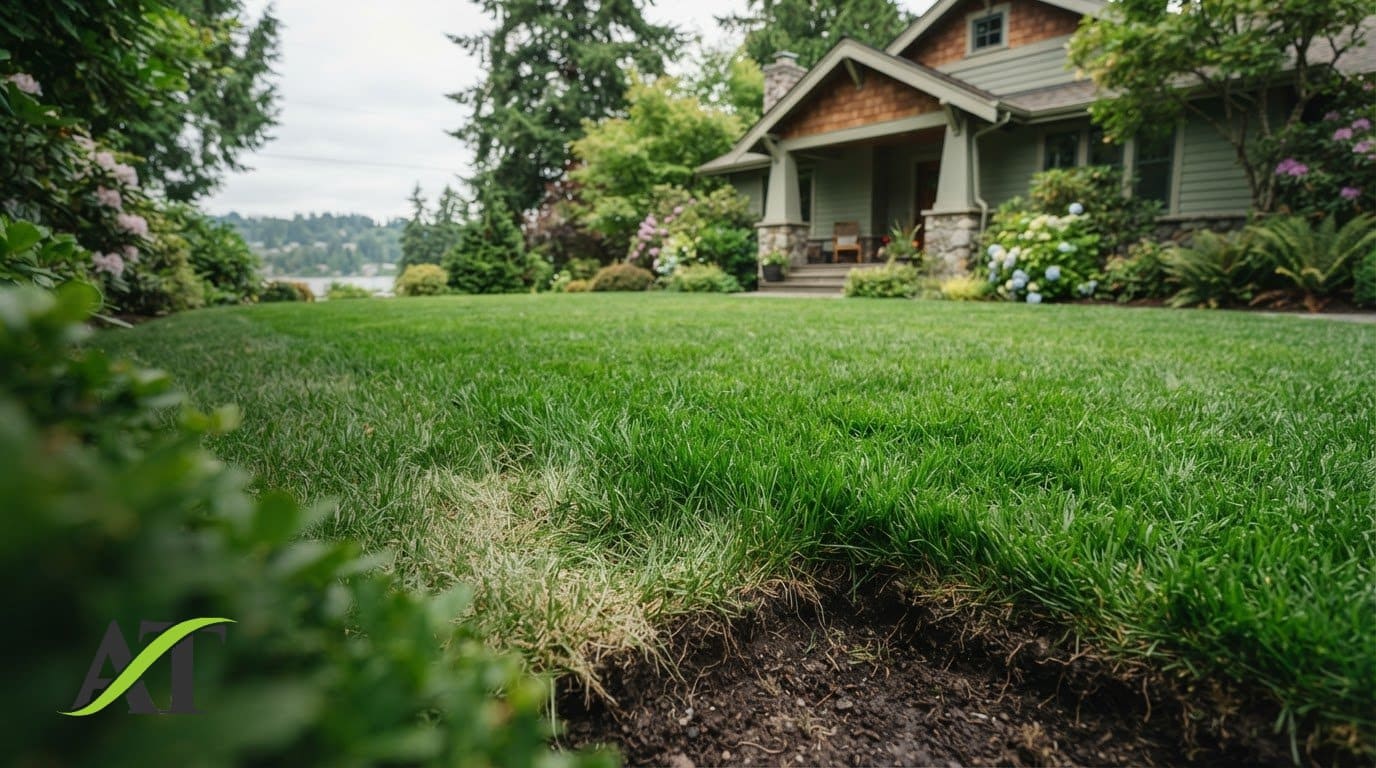
Your Brier lawn isn’t dying; it’s suffocating under the weight of Snohomish County’s heavy clay soil. You’ve likely spent weekends watering and mowing, only to see moss take over while the grass stays thin and patchy. It’s frustrating to watch your hard work wash away during the next PNW rainstorm because the ground is too hard to absorb a single drop. A professional Lawn Tune Up Brier homeowners can trust is often the missing link between a struggling yard and a thriving landscape.
This guide shows you how to restore your turf by tackling compaction and thinning grass without the massive expense of a full replant. You’ll learn how a Lawn Tune-Up, which consists of Core Aeration, Overseeding, and Fertilizing, works to transform soil health. We will also cover why monitoring soil temperatures between 55°F and 75°F is critical for seed success. This methodical approach creates thicker, greener grass that handles drainage properly and builds a foundation for long-term health.
Key Takeaways
- Learn how a professional Lawn Tune Up Brier service uses Core Aeration, Overseeding, and Fertilizing to fix compacted clay soil without the cost of a full replant.
- Discover why monitoring soil temperatures between 55°F and 75°F is the most accurate way to ensure grass seed germination in the Pacific Northwest.
- Understand the difference between a standard Lawn Tune-Up and the Full Meal Deal, which adds Power Raking (Dethatching) to the restoration process.
- Learn why hiring a local specialist founded in 2004 provides better results for your turf than a generalist mowing crew.
Why Brier Lawns Require a Professional Lawn Tune-Up
Most Brier yards sit on heavy clay common to South Snohomish County. This soil compacts easily. When it gets hard, grass roots can’t breathe or grow. Standard maintenance like mowing or edging won’t fix this. You need a Lawn Tune Up Brier homeowners rely on, which is a specific restoration process consisting of Core Aeration, Overseeding, and Fertilizing.
Watch for standing water after a light rain or soil that feels like concrete. Moss often moves in when grass stays sparse. These issues signal that your soil physics are failing. Applying the principles of turf management through mechanical restoration is the only way to reverse the damage without a full replant.
The Role of Core Aeration in Soil Decompression
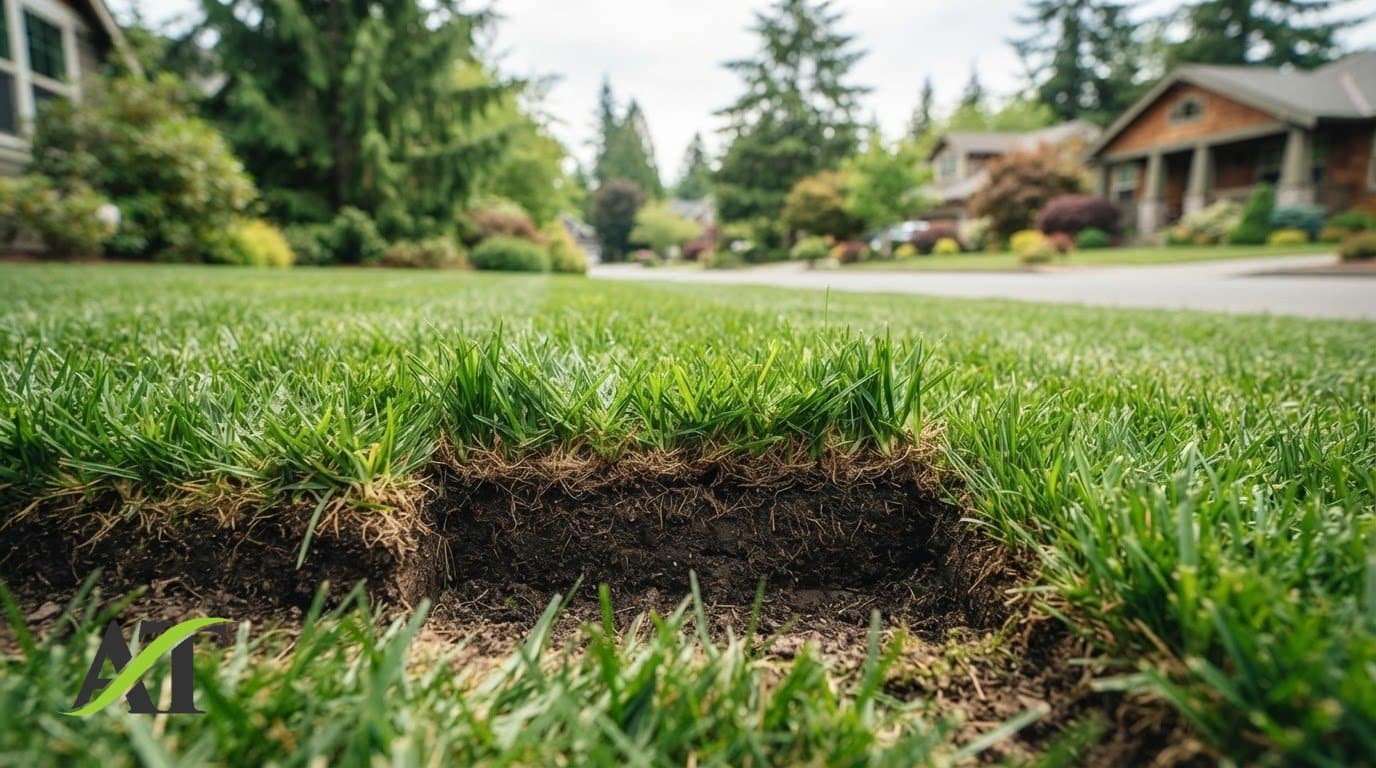
Core Aeration is the backbone of a Lawn Tune Up Brier residents use to fight compaction. We use professional equipment to pull small plugs of soil from the ground. This opens up pathways for oxygen, water, and nutrients to reach the root zone. In Brier’s gravelly or heavy clay soil, this decompression is vital. It breaks the surface tension and allows roots to dive deeper, creating a more resilient lawn.
Organic Fertilizing for Long-Term Vitality
We don’t believe in chemical spikes that cause a quick green-up followed by a crash. We use Organic Fertilizing to build soil structure over time. This approach feeds the biology of the soil, making it more hospitable for new growth. If your soil is particularly acidic, which is common in our region, you might also consider a lawn lime service Kenmore neighbors often use to balance pH levels.
The Science of Overseeding: Soil Temperature and Success Factors
Successful grass growth in Brier depends on biology, not luck. Many homeowners look at the thermometer on their porch, but air temperature is misleading in our variable PNW climate. Ground temperatures change more slowly than the air. The ideal soil temperatures for seeding fall between 55°F and 75°F (13°C to 24°C). While germination can happen outside this range, it will be slower and produce less reliable establishment.
We use high-quality seed blends specifically chosen for resilience in Brier landscapes. These varieties are selected to handle local soil and moisture levels. However, we don’t offer absolute germination guarantees. Results are influenced by multiple factors like moisture, seed-to-soil contact, and the weather. If you want a Lawn Tune Up Brier service that prioritizes these technical details, request a quote online.
Maximizing Seed-to-Soil Contact
Overseeding is most effective when paired with Core Aeration. During a Lawn Tune Up Brier project, the holes created by the aerator act as protected mini-nurseries. These pockets catch the seed, keeping it in direct contact with the earth and away from hungry birds or drying winds. Without these holes, seed often sits on top of the thatch and fails to take root.
Post-Service Care for Brier Homeowners
Your work begins once our machines leave. The first 21 days are critical for establishment. You must keep the soil surface consistently damp to support emerging sprouts. If the seed dries out after it begins to swell, the plant will die. Consistent moisture is the only way to ensure the new grass takes hold in the heavy local soil. For a detailed guide on managing your yard, check our lawn care after aeration checklist.
Lawn Tune-Up vs. The Full Meal Deal: Which is Right for You?
Choosing the right service depends on the current state of your turf. A standard Lawn Tune Up Brier homeowners often select is a three-part process: Core Aeration, Overseeding, and Fertilizing. This is the ideal choice if your main issues are hard soil and thinning grass. It focuses on decompressing the ground and introducing new growth to a relatively clean surface.
However, if your lawn feels spongy or is choked with moss, you need the Full Meal Deal. This comprehensive package includes Power Raking (Dethatching), Core Aeration, Overseeding, and Fertilizing. The addition of Power Raking (Dethatching) allows us to mechanically remove the “choke layer” of dead organic material. Learning how to control thatch in your lawn is vital because excessive buildup blocks water and nutrients from ever reaching the soil. It also helps the soil surface reach the 55°F to 75°F temperature range required for successful germination.
Identifying Thatch Buildup in Brier Yards
You can check your thatch levels with a simple “spongy” test. Walk across your yard and pay attention to the feel underfoot. If the ground feels bouncy rather than firm, you likely have more than half an inch of debris. While Power Raking (Dethatching) is an optional add-on to our base services, it’s a critical step for neglected properties. It clears the path for the restorative treatments that follow.
The Synergy of the Full Meal Deal
The Full Meal Deal works because each step builds on the last. By stripping away thatch first, Core Aeration becomes much more effective at pulling clean soil plugs. Overseeding success rates also climb because the seed falls directly onto the exposed earth. You can find more technical details in our guide to professional power raking in Lynnwood and how it prepares the ground for total restoration.

Booking Your Brier Lawn Restoration with Aerating Thatching Co.
Many homeowners hire a “mow and blow” crew and wonder why their grass never improves. Generalists focus on surface aesthetics, but they lack the tools and training for mechanical restoration. Since 2004, Aerating Thatching Co. has operated as a local, owner-operated specialist. We don’t mow or edge; we focus exclusively on the technical health of your turf. When you book a Lawn Tune Up Brier residents trust, you get the benefit of a contractor who has diagnosed every soil issue in Snohomish County.
We bring professional precision to every job. You can expect clean execution and expert advice on how to maintain your results. Unlike national chains with high turnover, our experience ensures that Core Aeration, Overseeding, and Fertilizing are performed correctly the first time. We handle the heavy lifting and the technical calibration so you can enjoy a thicker, greener lawn without the stress of manual labor.
Our Service Area and Local Commitment
We are deeply rooted in the community. Our primary focus includes Brier, Mountlake Terrace, and the surrounding areas of South Snohomish County. We understand the specific clay compositions and drainage patterns unique to this region. If you are ready to start your restoration, the first step is to request a quote. We provide accurate pricing based on your specific yard size to ensure transparency.
Specialized Tools for Superior Results
Superior outcomes require commercial-grade machinery. We use heavy-duty core aerators and power rakes that simply aren’t available at local rental shops. These machines are designed to penetrate the toughest clay and clear the thickest thatch layers effectively. We focus entirely on your lawn’s restoration, removing the burden of heavy equipment from your shoulders. This specialized approach ensures your Lawn Tune Up Brier project provides the best possible environment for your turf to thrive.
Restore Your Brier Turf Today
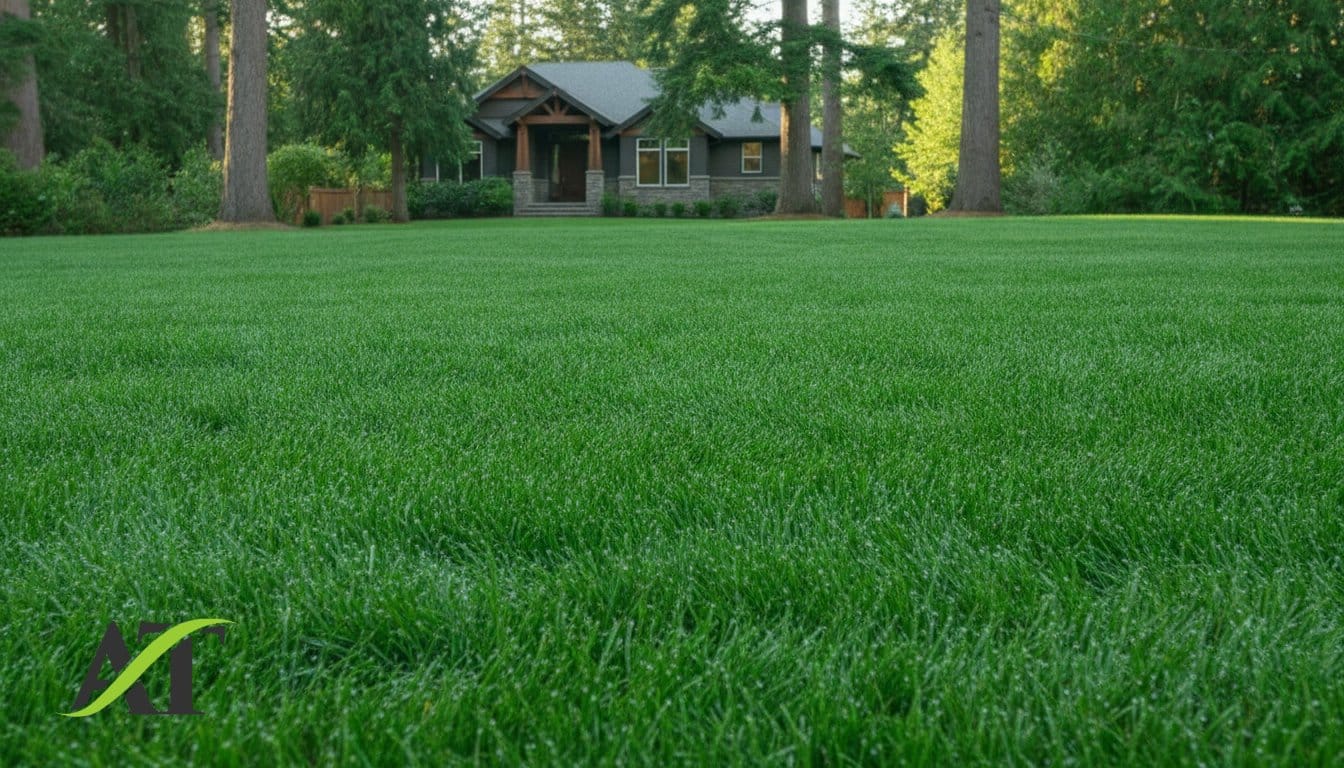
Brier’s heavy clay soil doesn’t have to mean a failing lawn. By focusing on soil physics through Core Aeration and Overseeding, you can bypass the cost and labor of a full replant. Remember that successful germination depends on maintaining soil temperatures between 55°F and 75°F and following a strict watering schedule. A professional Lawn Tune Up Brier, consisting of Core Aeration, Overseeding, and Fertilizing, provides the essential foundation for long-term health.
Aerating Thatching Co. has been owner-operated since 2004, specializing exclusively in Pacific Northwest soil restoration. We use professional-grade equipment and include Organic Fertilizing with every project to ensure your lawn has the nutrients it needs to thrive. We are your local partners in property maintenance, providing the technical expertise that generalists often miss.
Your yard is an investment. We look forward to helping you build a thicker, greener landscape that stands up to the local climate.
Frequently Asked Questions
What is the best time of year for a Lawn Tune-Up in Brier?
The best time for a Lawn Tune Up Brier project is during the spring and fall when soil temperatures are between 55°F and 75°F. These windows provide the consistent moisture and warmth required for cool-season grass to establish. If you wait until the heat of summer or the deep freeze of winter, germination will be slower and less reliable. We typically schedule these services when the ground is soft enough for effective aeration.
Does a Lawn Tune-Up include moss removal?
A standard Lawn Tune-Up focuses on Core Aeration, Overseeding, and Fertilizing, but it doesn’t include mechanical moss removal. If your yard has heavy moss buildup, you should choose the Full Meal Deal. That service adds Power Raking (Dethatching) to the process, which physically pulls moss and thatch from the soil surface. Removing this layer is essential for ensuring your new seed makes direct contact with the earth to grow properly.
How long does it take for the grass seed to germinate after Overseeding?
You can typically expect to see new growth within 10 to 21 days after Overseeding, provided you maintain consistent moisture. Success depends on soil temperature rather than air temperature, with the optimal range being 55°F to 75°F. We don’t offer absolute germination guarantees because results are influenced by weather, soil conditions, and how well the area is watered. Consistent dampness is the most important factor during this three-week establishment period.
Do I need to be home when you perform the Core Aeration?
You don’t need to be home when we perform Core Aeration or any of our restoration services. As long as our crew has clear access to the yard and pets are kept indoors, we can complete the work. We’ve been owner-operated since 2004, so you can trust us to handle your property with care. We’ll leave clear instructions for your post-service watering schedule on your door.
Can I mow my lawn immediately after a Lawn Tune-Up?
You should wait at least 21 days before mowing after a Lawn Tune Up Brier service. This gives the new seedlings time to develop a root system without being crushed by heavy mower wheels. When you do resume mowing, ensure your blades are sharp and set to a high setting. Since we don’t provide weekly mowing, you’ll need to coordinate this timing with your regular maintenance routine or provider.
Article by
Stewart Armour
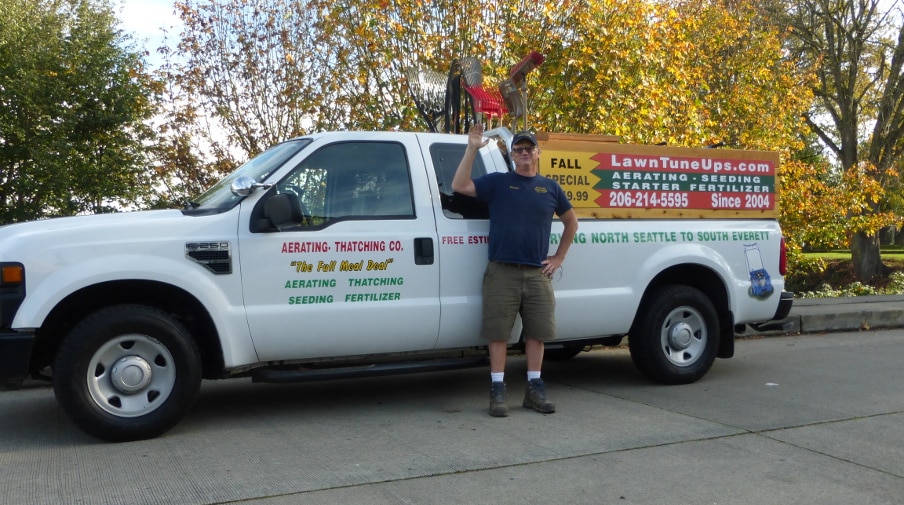
Stewart Armour is an independent lawn restoration expert, educator, and owner of Aerating Thatching Co., serving the greater Seattle area since 2004. With more than two decades of professional experience restoring Western Washington lawns, Stewart specializes in diagnosing lawn problems, improving soil health, and developing long-term lawn renovation strategies. His education includes turf management studies, advanced golf course turf training, and continuing education through Wilbur-Ellis University, State Turf Facilities, Soil First Academy, and Golf Course Applied Turf Physiology. Every article published on LawnTuneUps.com is grounded in practical field experience, current turf science, and a commitment to helping homeowners understand the why behind every recommendation—not just what to do.
Stewart has personally evaluated thousands of residential lawns throughout the Seattle area and remains committed to helping homeowners understand the science behind growing healthier, more resilient lawns.