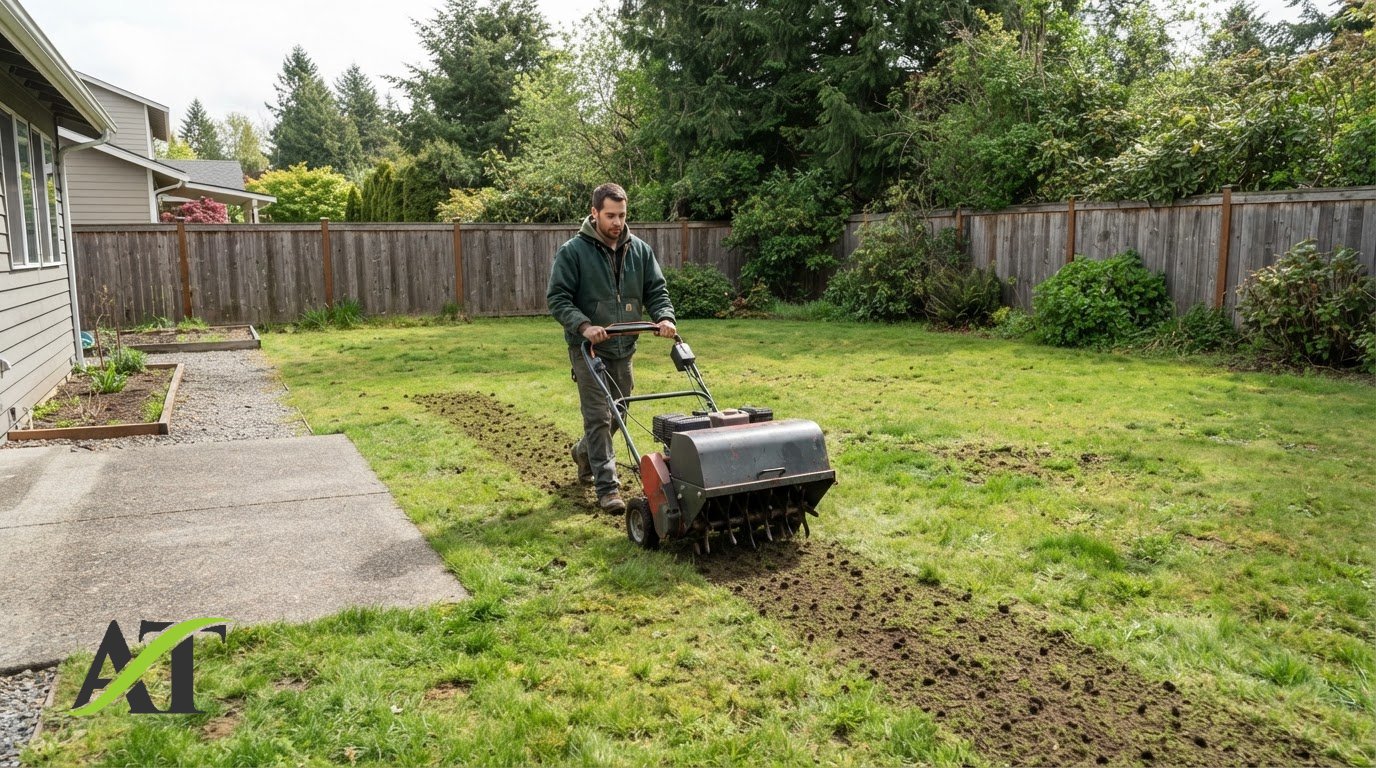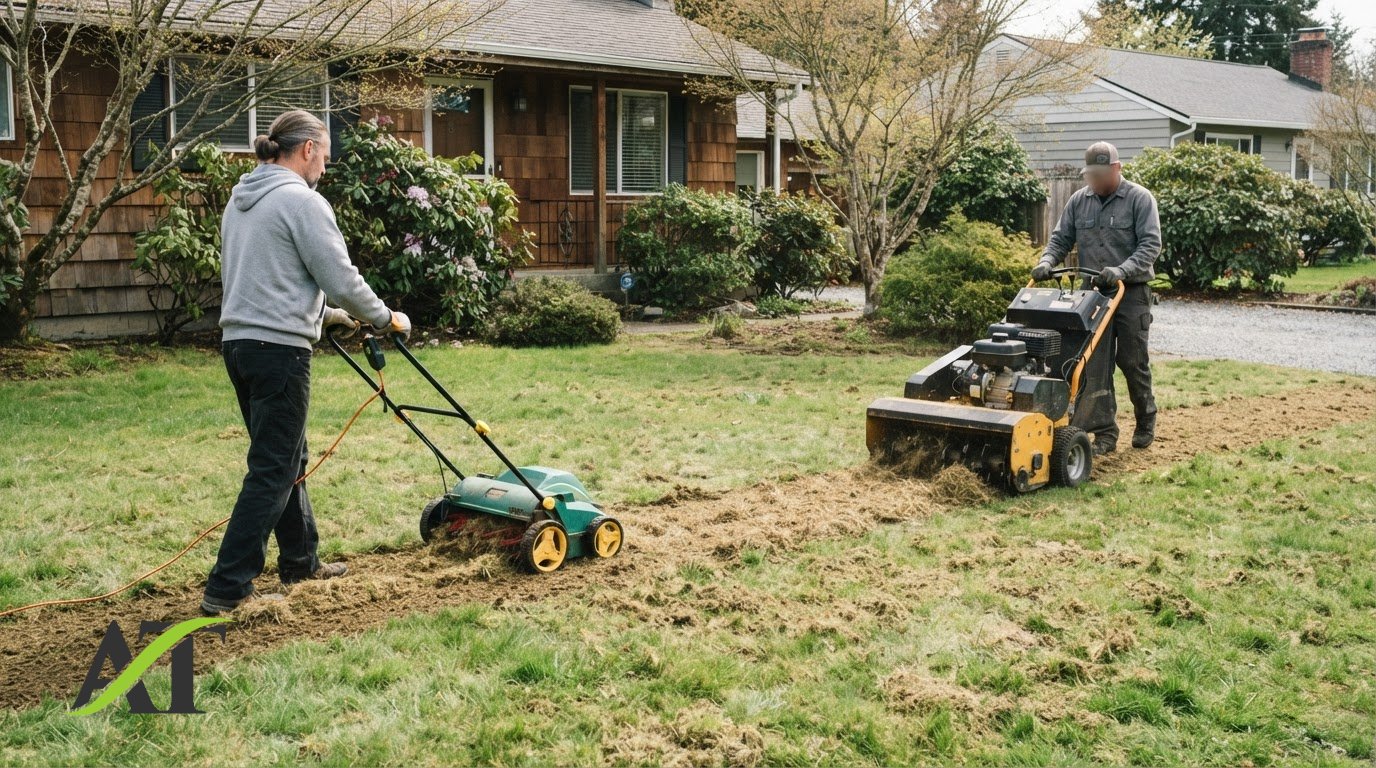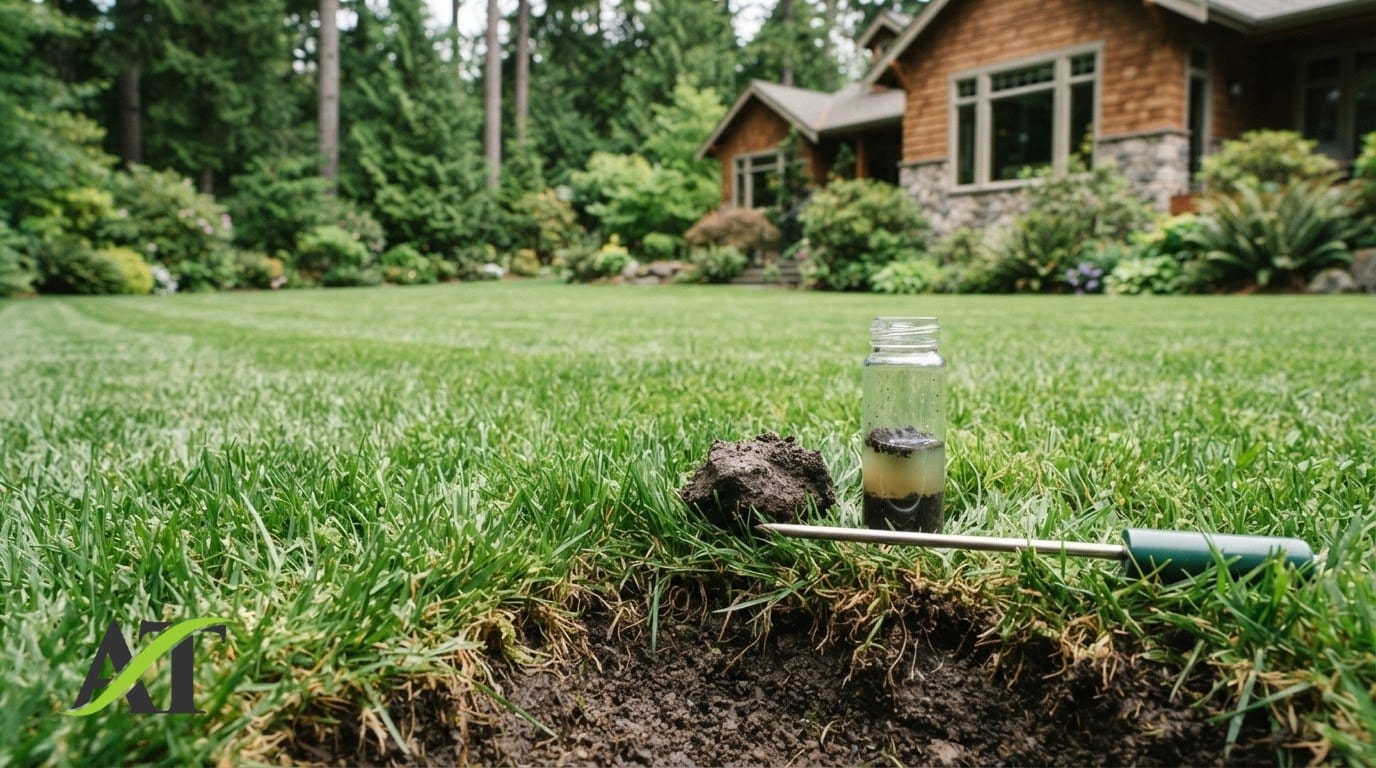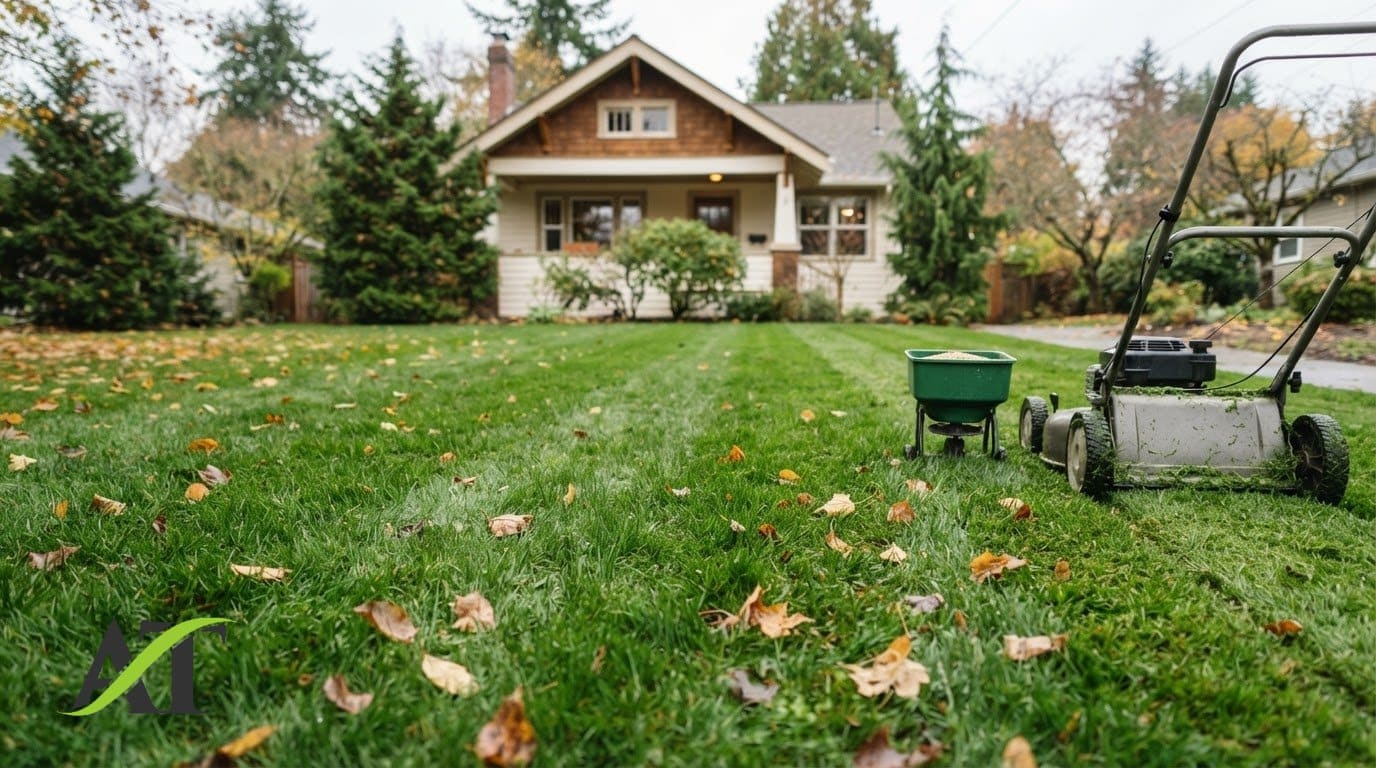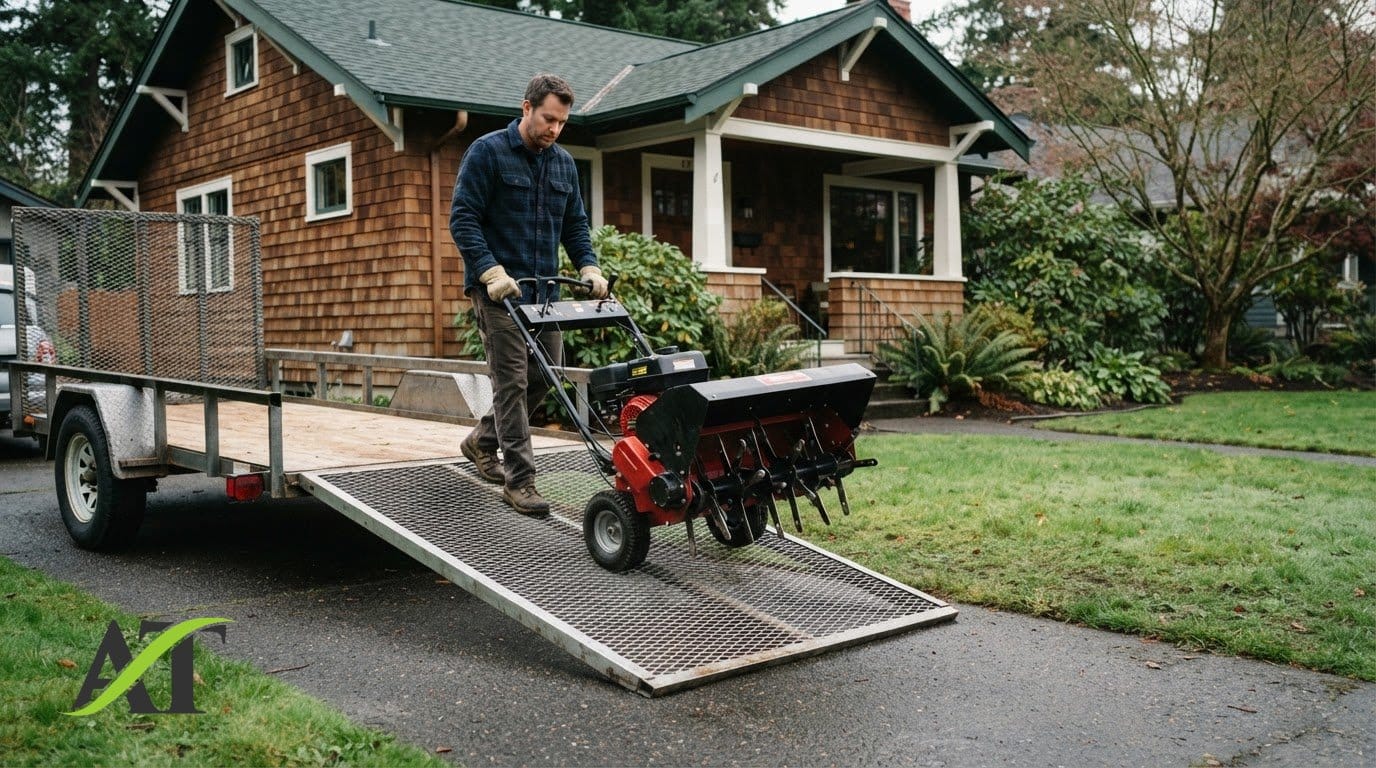
Schedule lawn aeration during active growth, when the soil is moist enough for tines to enter but not saturated. Spring and fall can provide suitable windows for Seattle-area cool-season lawns; do not default to late fall if the lawn has not entered an appropriate growth period. Soil conditions matter more than the calendar.
Timing matters more than simply getting the machine home. Tines need workable soil, not ground so dry they bounce or turf so saturated it gets churned up. If the lawn is dry, water it the day before aerating.
This guide explains when Core Aeration makes sense for Seattle-area lawns, what it can and cannot address, and how core, spike, ride-on, and tow-behind aerators differ. It also covers manual hollow-tine tools for smaller areas and when compaction may not be the main issue. Aerating Thatching Co. provides aeration services rather than equipment rentals, so use these points to decide whether to handle the work yourself or request service.
Key Takeaways
- Schedule aeration during active growth when the soil is moist but not saturated, rather than choosing a date simply because equipment is available.
- Equipment-use periods vary by provider; examples may include a short same-day window or a longer 24-hour period.
- Core aerators remove soil plugs, spike aerators puncture the surface, ride-on models suit open areas, and tow-behind units attach to a vehicle.
- Core Aeration addresses compaction in the shallow turf root zone, but deeper drainage problems or other lawn issues may need a different diagnosis.
- Aerating Thatching Co. provides Core Aeration and related lawn services, not equipment rentals.
When Should I Aerate a Lawn?
For Seattle-area cool-season lawns, schedule Core Aeration during active growth, in spring or fall when conditions are suitable. The soil should be damp but not saturated. If the ground is dry, water the lawn before aerating; if it is saturated, wait until it can support equipment without rutting. Late fall is not an automatic target if the lawn is not actively growing.
If you plan to use equipment yourself, confirm the machine type, operating instructions, and transport requirements with the provider before committing. If you would rather have the work handled, Aerating Thatching Co. provides Core Aeration and can help match the service to the lawn’s condition.
Safety warning: Operating unfamiliar heavy machinery can cause muscle strain, loss of control, and serious injury. Read the manufacturer’s manual and safety decals, use the recommended protective equipment, keep people and pets clear, and learn the controls before starting. Use the transport setting when moving the machine. If you are not comfortable loading, maneuvering, or operating the equipment, professional aeration service is the safer choice.
How long might equipment be available?
Equipment-use periods are provider-dependent examples, not fixed industry terms. A provider may offer a short same-day window, such as four hours, or a longer period, such as 24 hours. Choose a period that allows time for loading, unloading, setup, operation, and return without rushing, and confirm the actual terms with the provider.
- Short same-day example: A provider may offer a four-hour window for a straightforward lawn that can be completed within that period.
- Longer-period example: A provider may offer 24 hours when the lawn has separate sections, limited access, or a more involved setup.
If you are weighing equipment use against having lawn work handled for you, review the available lawn services or request a quote.
Core, spike, ride-on, and tow-behind aerators
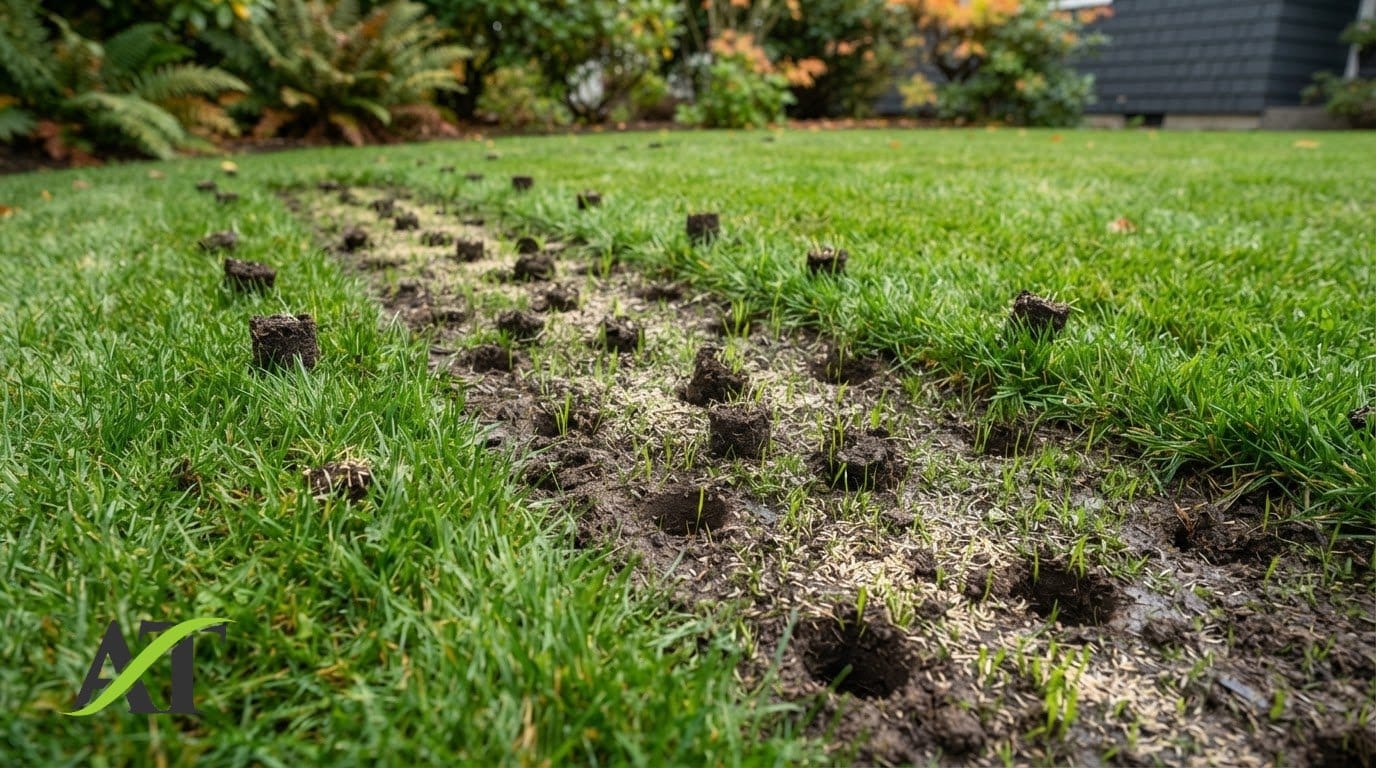
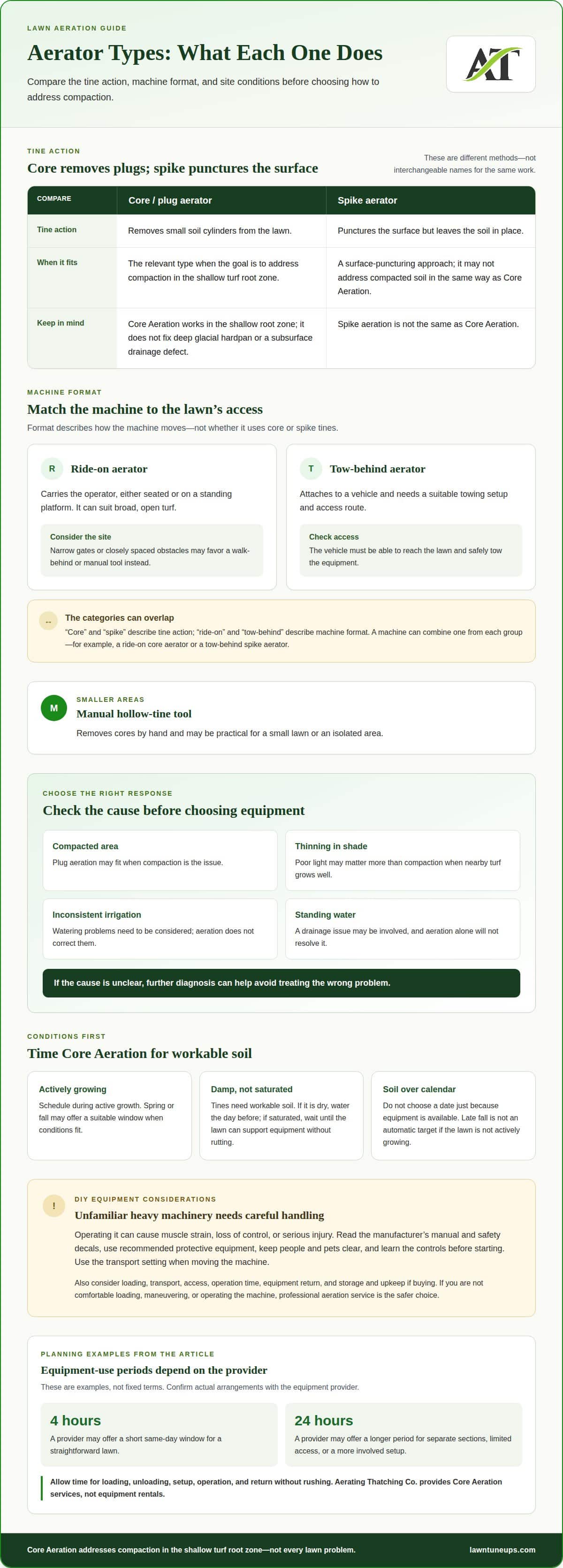
These terms describe two different things. “Core” and “spike” describe the tine action: a core aerator, also called a plug aerator, removes small soil cylinders, while a spike aerator punctures the surface but leaves the soil in place. “Ride-on” and “tow-behind” describe the machine format: a ride-on aerator carries the operator, while a tow-behind aerator attaches to a suitable vehicle. The categories overlap, so a machine can be, for example, a ride-on core aerator or a tow-behind spike aerator. Not all ride-on aerators are seated; some models have standing platforms. Manual hollow-tine tools remove plugs by hand and can suit smaller areas.
Choose a method based on the problem you want to address. Compacted soil is a reason to consider plug aeration. But a lawn struggling in shade, receiving inconsistent irrigation, or staying wet because of a drainage defect may have another underlying issue. Aeration won’t correct poor light, watering problems, or subsurface drainage. Deep glacial hardpan is also beyond the reach of Core Aeration.
- Core or plug aerator (tine action): Removes small soil cores and is the relevant type when relieving compaction in the shallow turf root zone is the goal.
- Spike aerator (tine action): Makes holes without removing soil plugs. It is different from Core Aeration and may not address compacted soil in the same way.
- Ride-on aerator (machine format): Carries the operator, either seated or on a standing platform, and can suit broad, open turf.
- Tow-behind aerator (machine format): Attaches to a vehicle and requires a suitable towing setup and access route.
- Manual hollow-tine tool: Removes cores by hand and may be practical for a small lawn or isolated area.
Look for patterns across the lawn before choosing equipment. If foot traffic has left an area compacted, plug aeration may fit the problem. If grass is thinning only in a shaded patch while nearby turf grows well, shade may matter more than compaction. Standing water can point to a drainage issue that aeration alone won’t resolve.
Consider access as well as the soil problem. A ride-on model may suit open turf, while narrow gates or closely spaced obstacles may favor a walk-behind or manual hollow-tine tool. A tow-behind model requires a vehicle that can reach and safely tow it. The right option fits both the lawn’s needs and the site layout.
For Seattle lawns, distinguish compaction from thatch, shade, irrigation, and drainage trouble before choosing a method. If the cause isn’t clear, further diagnosis can prevent treating the wrong problem.
What to weigh before choosing equipment or service
To decide whether using equipment yourself makes sense, look beyond the time spent aerating. You may need to arrange transport, load and operate unfamiliar machinery, manage access, and complete the work safely. Aerating Thatching Co. provides aeration services for homeowners who would rather have this work handled.
Think about how often you expect to use an aerator and whether you have a suitable place to store one if you buy. A one-time project may not justify the long-term storage and upkeep. If you expect to aerate regularly, owning a machine may suit you, provided you can handle its operation and care.
Before committing, make a simple list of the work involved:
- Arrange a suitable vehicle and loading setup.
- Set aside time for operation and equipment return.
- Plan for storage and upkeep if considering a purchase.
- Decide whether you want to operate the machine yourself.
Then compare that workload with having the work done for you. Aerating Thatching Co. provides Core Aeration to relieve compaction in the shallow turf root zone. If the lawn is also thin and needs new grass, the Lawn Tune-Up combines Core Aeration, Overseeding, and Fertilizing. Renting or borrowing equipment puts transport and operation in your hands; choose based on the lawn’s condition and the effort you are ready to take on.
Aerating Thatching: Core Aeration
Aerating Thatching Co. provides Core Aeration when compacted soil in the shallow turf root zone is the problem. The process removes small soil cores and can support air exchange, water movement, and nutrient uptake. It won’t break deep glacial hardpan or correct a subsurface drainage defect, so persistent wet areas may need further diagnosis.
If the lawn also needs new grass, a Lawn Tune-Up combines Core Aeration, Overseeding, and Fertilizing. Overseeding should be scheduled only during an appropriate active-growth seed window, with soil moisture suitable for establishment; it is not required for every reasonably dense lawn. For our Premium 60/40 Sun & Shade Mix, the qualified soil-temperature window is 55–80°F. Review the Lawn Tune-Up service details and the lawn after-care guidance for the work and care that follow.
Frequently Asked Questions
Where can I rent a lawn aerator near me?
Aerating Thatching Co. does not rent equipment; the business provides owner-operated lawn aeration services in North Seattle, North King County, and South Snohomish County. Homeowners who plan to use equipment themselves can contact local rental providers to ask about available machine types, provider-dependent use periods, transport requirements, and operating instructions. Homeowners who prefer professional service can request a quote from Aerating Thatching Co.
What are the differences between core, spike, ride-on, and tow-behind aerators?
Core and spike describe tine action: core aerators remove soil plugs, while spike aerators puncture the soil without removing plugs. Ride-on and tow-behind describe machine format: ride-on aerators carry the operator (seated or standing, depending on the model), while tow-behind models attach to a suitable vehicle. The categories overlap. Manual hollow-tine tools remove plugs by hand and may suit smaller areas.
Should I rent or buy a lawn aerator for my yard size and needs?
Using equipment yourself can suit a homeowner who needs it occasionally and has a practical way to transport and operate it safely. Buying may suit someone who expects repeated use and has suitable storage, but neither option is necessary when professional service is preferable. Consider the lawn’s access, the equipment type, and the time and physical effort required. Aerating Thatching Co. provides Core Aeration rather than equipment rentals.
How do I reserve, pick up, transport, and return a rented lawn aerator?
Choose a suitable day, then confirm the machine, pickup window, accessories, and return terms. At pickup, review the operating instructions and note the machine’s condition. Use a vehicle and loading equipment suited to its dimensions and weight, and secure it for transport. Return it by the agreed deadline and in the condition required by the rental agreement.
When is the best time to aerate a lawn, and how should I prepare it?
For Seattle-area lawns, schedule Core Aeration during active growth in spring or fall when the soil is moist but not saturated. Do not default to late fall if the lawn is not in an appropriate growth period. Before service, mark sprinkler heads, oil tank caps, shallow utilities, and pet fencing, and keep the route clear. If the lawn is thin, Overseeding may be appropriate only when conditions fall within a suitable active-growth seed window; it is not necessary for every lawn. After service, follow the after-care guidance for watering, mowing, and managing foot traffic.
Article by
Stewart Armour
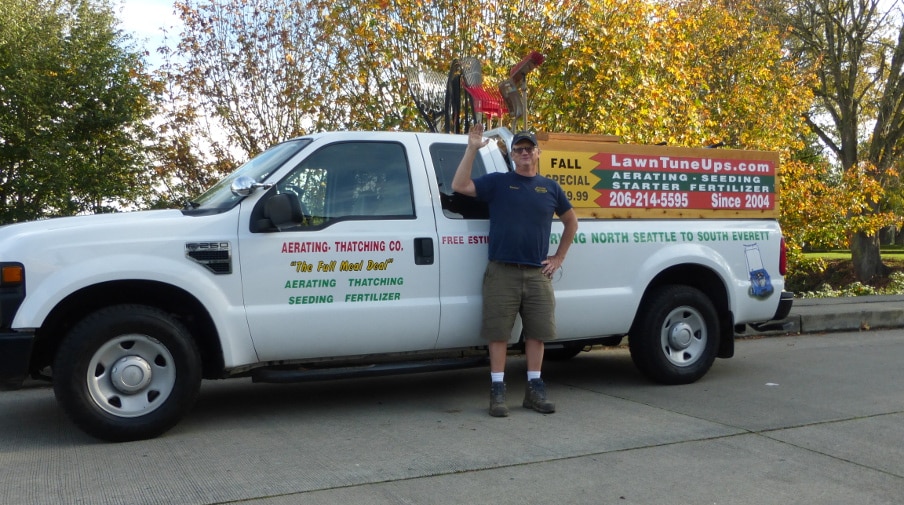
Stewart Armour is the owner of Aerating Thatching Co., an owner-operated Seattle-area lawn restoration business established in 2004. He helps homeowners understand Core Aeration, Power Raking (Dethatching), Overseeding, soil conditions, and the aftercare needed for stronger lawns. His background includes turf management study, advanced golf course turf training, and continuing education through Wilbur-Ellis University, State Turf Facilities, Soil First Academy, and Golf Course Applied Turf Physiology. Stewart has personally evaluated thousands of residential lawns throughout the Seattle area and focuses on recommending the work that fits each lawn’s condition.