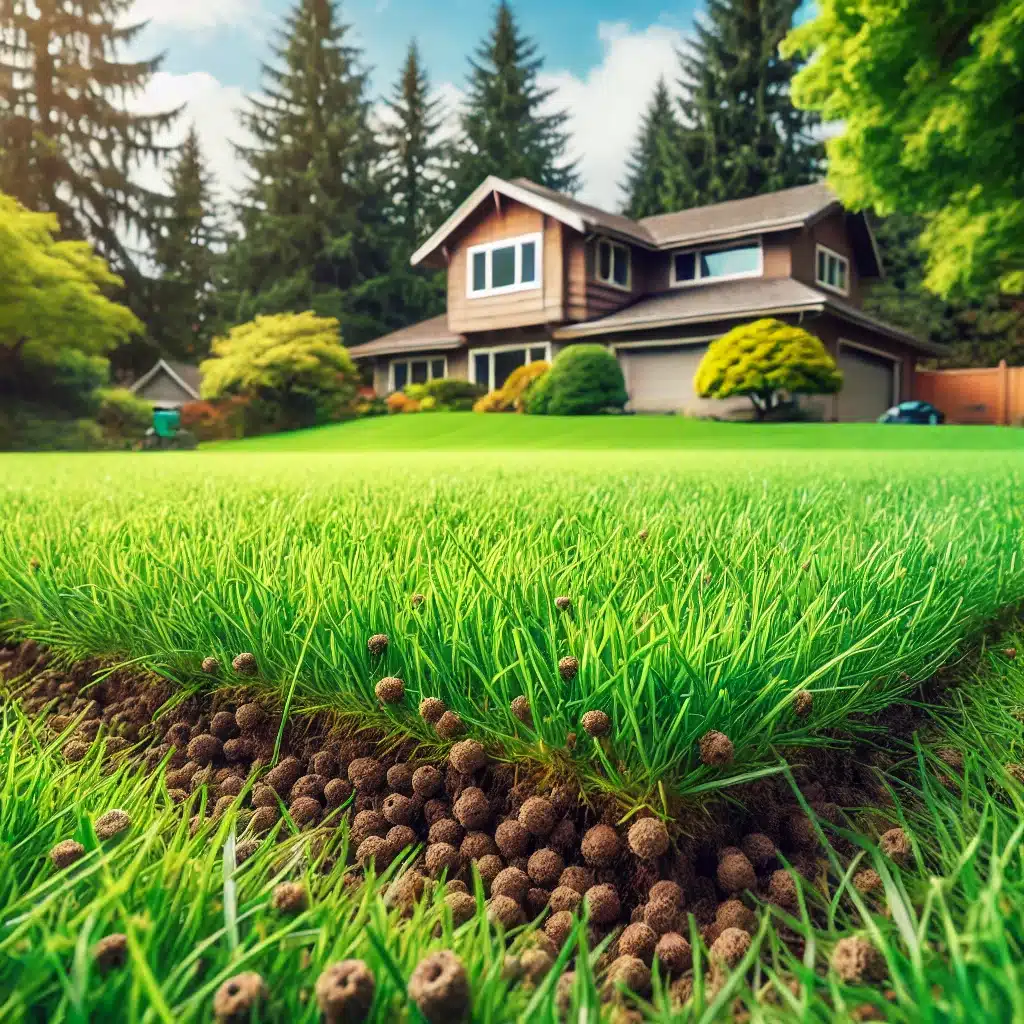
Mushrooms in Seattle Lawns: Identification, Impact, and Prevention
If you’ve noticed mushrooms popping up in your Seattle lawn, you’re not alone. Cool, damp Pacific Northwest weather can produce visible mushrooms in lawns, especially when moisture and decomposing organic material are present.
Mushrooms appearing in a Seattle lawn do not automatically mean the lawn is diseased or unhealthy. They are the visible fruiting bodies of fungi that may be breaking down organic material in or beneath the lawn. Rain and prolonged moisture can make those fruiting bodies appear suddenly. In many cases, the practical response is to remove visible mushrooms when necessary, avoid unnecessary irrigation, and look for underlying lawn problems only when other symptoms are present.
Why Does My Seattle Area Lawn Have Mushrooms?
Mushrooms are common sights in lawns during periods of mild, wet weather. In Western Washington, mushrooms may be particularly noticeable during spring and fall, although a rainy stretch at another time of year can also trigger visible fruiting.
The mushroom you see above the soil is only the fruiting body. The main fungal growth can be present in soil, thatch, roots, buried wood, or other organic material before conditions are right for mushrooms to appear.
Mushroom-forming fungi in lawns commonly function as decomposers, breaking down organic material such as dead roots and other plant material. Their presence can therefore reflect normal decomposition rather than a disease attacking healthy grass.
Organic Material
Decaying roots, old stumps, buried wood, bark, leaves and other organic material can provide a food source for mushroom-forming fungi.
Cool, Wet Conditions
Moisture can trigger mushrooms to fruit. Seattle's rainy periods can make mushrooms appear quickly even when the fungal growth was already present.
Localized Moisture
Poorly draining areas, irrigation problems, or places where water remains longer can create conditions favorable to visible mushroom growth.
Shade and Microclimates
Shaded areas can stay damp longer than exposed portions of the lawn. Shade does not cause mushrooms by itself, but it can contribute to a cooler, wetter microclimate.
Why Mushrooms Can Appear Suddenly in Seattle
A homeowner may see very few mushrooms one week and dozens the next. That doesn't necessarily mean a new lawn problem developed overnight. Fungal growth can already be present below the surface, while a change in temperature and moisture triggers the production of visible fruiting bodies.
Washington State University identifies mild, moist conditions as favorable for fairy-ring mushrooms, with spring and fall being common periods for their appearance in Pacific Northwest lawns.
How to Recognize Mushrooms in Your Lawn
Lawn mushrooms can vary considerably in shape, size, color and structure. Some have caps and stems, while others may appear as puffballs or other less-familiar forms. Because mushroom identification can be difficult, especially from a photograph alone, this article focuses on recognizing general lawn mushroom patterns rather than trying to identify a species as edible, poisonous or harmless.
Common Things You May Notice
- Small or medium mushroom caps appearing above the grass.
- Mushrooms appearing in clusters, arcs or circles.
- Mushrooms appearing shortly after rain or during extended damp weather.
- Mushrooms concentrated around trees, old stumps or particular lawn areas.
- Occasional puffballs or other unusual fungal fruiting bodies.
Important: Don't Try to Decide Whether a Mushroom Is Safe to Eat
Some mushrooms can be toxic. Appearance alone is not a reliable basis for deciding whether an unidentified mushroom is safe to eat.
If children or pets use the lawn, remove visible mushrooms when practical and prevent ingestion. If someone or a pet may have eaten an unidentified mushroom, seek appropriate medical, veterinary or poison-control guidance rather than trying to diagnose the mushroom from this article.
Do Mushrooms Harm My Lawn?
Seeing Mushrooms Does Not Automatically Mean Your Lawn Has a Disease
This distinction is important. Many lawn mushrooms are simply the visible fruiting bodies of fungi decomposing organic material. Their presence does not automatically mean the grass has a fungal disease.
Actual turf diseases are evaluated by looking at symptoms in the grass, roots or crowns—not simply by seeing mushrooms nearby. Western Washington does have genuine turf diseases, but those diseases have their own symptoms and environmental conditions.
Mushrooms themselves generally aren't the main concern for an otherwise healthy lawn. The more useful question is whether the lawn also has another problem: thinning grass, persistent standing water, compaction, excessive thatch, drought stress, dead areas, or another visible turf symptom.
A mushroom can also simply be part of the natural decomposition of organic material in the soil. The fungus is using material that is already present, rather than necessarily attacking healthy grass.
How to Manage Mushrooms in a Seattle Lawn
For most homeowners, the goal should not be to eradicate every fungus beneath the lawn. A more practical approach is to manage the visible mushrooms when needed and correct genuine lawn conditions that can be improved.
1. Remove Visible Mushrooms When Necessary
Raking or hand-removing visible mushrooms can improve the appearance of the lawn and reduce the opportunity for children or pets to encounter them. Gloves are a sensible precaution when handling unidentified mushrooms.
Raking or mowing off visible mushrooms and puffballs is recognized as a cultural management option for fairy rings and other mushroom-producing fungi in lawns.
Removing the visible mushroom does not necessarily remove the fungal growth below the soil, so mushrooms can return when conditions become favorable again.
2. Avoid Unnecessary Watering
If Seattle is already providing plenty of rain, additional irrigation may simply add moisture the lawn doesn't need. Avoid watering automatically just because the calendar says it is time.
If one section of lawn stays wet substantially longer than surrounding areas, look for an irrigation problem, low area, drainage issue or other explanation for the difference.
3. Look at Drainage and Compaction When There Is an Actual Problem
Mushrooms alone are not proof that the lawn needs aeration. However, if the lawn also has compacted soil, poor water penetration, weak growth or other signs of a soil-condition problem, those issues are worth evaluating.
Core Aeration can be appropriate when compaction is genuinely part of the lawn problem. It should not be presented as a mushroom-killing treatment.
4. Clean Up Surface Organic Debris
Keep leaves, branches and other loose organic debris from accumulating heavily on the lawn. Where there is genuinely excessive thatch, the appropriate question is whether the lawn needs Dethatching (Power Raking) , not whether every mushroom needs to be removed.
5. Consider the Lawn's Overall Condition
If the lawn is already reasonably dense and healthy and mushrooms appear for a short period after rain, there may be nothing significant to correct.
If the lawn is thin, compacted, patchy or declining at the same time, the broader lawn condition deserves attention. In that situation, the right service depends on what the lawn actually needs rather than on the presence of mushrooms alone.
6. Don't Try to Dry Out a Rain-Soaked Seattle Lawn
Homeowners cannot control prolonged Pacific Northwest rainfall. The goal is to avoid adding unnecessary irrigation and to correct controllable drainage or watering problems—not to force a naturally wet lawn to become dry during rainy weather.
Why Mushrooms Keep Coming Back
Removing a mushroom removes the visible fruiting body, not necessarily the fungal growth below the surface. If the underlying organic material and environmental conditions remain, another flush of mushrooms can appear later.
This is especially understandable when mushrooms repeatedly appear in the same localized area. Possible contributors include decomposing roots, an old stump, buried wood, accumulated organic material, or a persistent moisture pattern.
Repeated Mushrooms in One Spot?
Look at the lawn around the mushrooms rather than focusing only on the mushrooms themselves. Is the grass thinner there? Does the area stay wet longer? Was there once a large tree or stump there? Is there a noticeable difference in soil or thatch?
Those observations can be more useful than repeatedly applying a product to the visible mushrooms.
Should You Dig Up the Lawn?
Usually not just because mushrooms appeared. If an accessible old stump, buried wood or similar organic source is clearly associated with a persistent problem, removing that material may reduce future fungal fruiting. But excavating an otherwise healthy lawn simply to eliminate ordinary mushrooms would generally be excessive.
Extensive soil removal or renovation is generally reserved for unusual, severe fairy-ring situations rather than ordinary mushroom appearances in an otherwise healthy lawn.
What NOT to Do About Lawn Mushrooms
Don't Treat the Mushroom Before Understanding the Lawn
- Don't apply lime just because mushrooms appeared. Soil pH should be addressed based on an actual soil need, not simply because mushrooms are visible.
- Don't assume mushrooms mean turf disease. The mushroom itself is not a diagnosis of a grass disease.
- Don't automatically reach for fungicide. Chemical control is not generally recommended for fairy rings because treatment can be difficult and results can be limited or inconsistent.
- Don't overwater trying to flush mushrooms away. Additional moisture can work against you.
- Don't expect raking or mowing to permanently eliminate the fungus. Visible mushroom removal is practical management, not eradication of the underground fungal growth.
When Should I Be Concerned?
A few mushrooms appearing after a wet period usually aren't a lawn emergency. The situation deserves closer attention when mushrooms occur alongside other lawn symptoms or when the pattern is persistent enough to suggest an underlying condition worth investigating.
- The grass is thinning, dying or becoming noticeably stressed around the mushrooms.
- The same area repeatedly stays wet or has standing water.
- A pronounced ring or arc of unusually green or declining grass develops.
- Mushrooms repeatedly appear in exactly the same localized area.
- There is an old stump, buried wood or large tree-root area beneath the lawn.
- The lawn also has significant compaction or a heavy thatch layer.
- Children or pets have access to unidentified mushrooms.
- You are unsure whether what you're seeing is an ordinary mushroom or a symptom of a turf disease.
When the grass itself is declining, focus on diagnosing the lawn condition rather than assuming the mushroom is the cause.
What About Fairy Rings?
Fairy rings are one of the more recognizable mushroom-related patterns in lawns. They can appear as circles or arcs of darker green grass, sometimes with mushrooms or puffballs along the ring. In some cases, stressed or dead turf can occur within or near the ring.
Fairy rings are a recognized lawn issue in Western Washington and are more likely to become noticeable during mild, moist conditions.
Fairy-ring fungi can break down organic material such as dead tree roots, buried plant material and other sources of organic matter beneath or around the lawn. In home lawns, fairy rings are generally considered a relatively minor turf problem.
What Can You Do About a Fairy Ring?
- Rake or mow off visible mushrooms or puffballs.
- Pay attention to watering and avoid unnecessary irrigation.
- Look at soil penetration and drainage if the turf is also struggling.
- Maintain the lawn appropriately so the grass can continue growing through the affected area.
- Consider core aeration when compaction or poor water penetration is independently part of the lawn problem.
Fungicides should not automatically be considered the answer. Chemical control of fairy rings is not generally recommended because treatment is difficult to distribute effectively through the soil and results can be limited or inconsistent.
Can Aeration Help With a Mushroom Problem?
Aeration can help with certain underlying lawn conditions, but it is not a mushroom-control treatment.
If the lawn has genuine soil compaction or poor water penetration, Core Aeration may be useful for the lawn's overall condition. Coring is also included among cultural management practices discussed for fairy rings because it can help water penetrate affected areas.
That is different from saying every lawn with mushrooms needs aeration. If your lawn is otherwise healthy and the mushrooms simply appeared after rain, aeration may not be necessary.
If you are trying to decide whether your lawn needs more than aeration, compare the options through Aerating Thatching Co.'s lawn services .
What About Dethatching (Power Raking)?
Mushrooms are not, by themselves, proof that a lawn needs Dethatching (Power Raking). The relevant question is whether the lawn actually has a substantial surface layer of thatch or accumulated material that needs to be removed.
If a lawn has heavy thatch, moss or accumulated surface material in addition to mushroom activity, Dethatching (Power Raking) may become part of a broader lawn-restoration plan.
If the lawn is thin and needs both compaction relief and greater grass density, a Lawn Tune-Up combines Core Aeration, Premium Overseeding and Starter Fertilizer.
If significant thatch or moss needs to be removed before rebuilding the lawn, the Full Meal Deal Lawn Renovation may be the more appropriate restoration approach.
The important point is that mushrooms alone should not automatically push a homeowner into the largest lawn service.
Recommended Lawn Tools & Resources
As an Amazon Associate, we may earn from qualifying purchases.
These are general lawn-care tools and resources that can be useful when investigating or cleaning up a mushroom-prone lawn. None of these products should be viewed as a mushroom treatment, and the presence of mushrooms alone does not mean you need to buy a product.

The Lawn Bible
A general lawn-care reference for homeowners who want to better understand turf maintenance, lawn conditions and common lawn-care decisions. It is not a mushroom-specific treatment guide.
View on Amazon
Groundskeeper II Rake
A practical cleanup tool for raking visible mushrooms and loose surface debris. Removing visible mushrooms can improve appearance and reduce exposure around children and pets, but it does not eliminate the fungus below the soil.
View on Amazon
Soil Sampler With Footstep
Useful for taking a closer look below the turf surface, including soil depth, moisture differences and thatch or organic layers. It is an investigation tool—not a way to identify the mushroom species or diagnose a fungal disease.
View on Amazon
3-in-1 Soil Moisture, Light & pH Meter
A general lawn-condition tool for checking moisture and soil pH. Use it to investigate the lawn rather than assuming mushrooms mean the soil needs lime. Do not apply lime simply because mushrooms appeared.
View on AmazonShould I Change My Lawn's Soil pH?
Not simply because mushrooms appeared.
Soil pH is a separate lawn-management consideration. If a soil test shows that your lawn actually needs a pH adjustment, lime may be appropriate based on that soil condition. But mushrooms themselves are not sufficient evidence that the soil is too acidic.
This distinction matters because adding lime without an identified need can turn a simple mushroom question into an unnecessary soil-treatment project.
Should I Use Fungicide?
Not simply because mushrooms are growing in the lawn.
Visible mushrooms are fruiting bodies, and treating them as though they are automatically a turf disease can lead to unnecessary chemical applications.
For fairy rings specifically, chemical control is not generally recommended because treatment can be difficult to distribute effectively through the soil and results may be limited or inconsistent.
If the grass itself is showing symptoms that look like a turf disease, identify the actual disease problem before choosing a treatment.
Practical DIY Mushroom Management Checklist
- Remove visible mushrooms when you want the lawn cleaned up.
- Use gloves when handling unidentified mushrooms.
- Keep children and pets from eating or handling unidentified mushrooms.
- Avoid unnecessary irrigation during wet Seattle weather.
- Look for localized standing water or irrigation problems.
- Remove loose leaves and other surface debris that accumulates on the lawn.
- Notice whether mushrooms repeatedly occur around an old tree, stump or particular area.
- Look at the grass itself for thinning, dead patches or other symptoms.
- Consider aeration only when compaction or water penetration is independently a lawn concern.
- Consider Dethatching (Power Raking) only when the lawn actually has a significant thatch or surface-material problem.
Frequently Asked Questions About Mushrooms in Seattle Lawns
Why are mushrooms suddenly growing in my Seattle lawn?
Mushrooms can appear suddenly when moisture and temperature conditions trigger fungal fruiting. The underlying fungal growth may already have been present in soil, thatch, roots, buried wood or other organic material.
Do lawn mushrooms mean my grass has a fungal disease?
No. Seeing mushrooms does not automatically mean the grass has a fungal disease. Many lawn mushrooms are associated with fungi decomposing organic material. Turf disease should be evaluated from symptoms in the grass, roots or crowns rather than the presence of mushrooms alone.
Are lawn mushrooms poisonous to dogs, pets or children?
Some mushrooms can be toxic, and unidentified mushrooms should not be assumed safe to eat. Remove visible mushrooms where practical and prevent children and pets from ingesting them. If ingestion is suspected, seek appropriate medical, veterinary or poison-control guidance.
Will mowing or raking get rid of mushrooms permanently?
No. Mowing, raking or hand-removing visible mushrooms removes the fruiting bodies but does not necessarily eliminate the fungal growth below the lawn. Mushrooms can return when conditions become favorable.
Should I apply lime to get rid of lawn mushrooms?
No. Mushrooms appearing in the lawn are not, by themselves, a reason to apply lime. Soil pH should be addressed when there is an actual soil need, preferably established through appropriate soil testing.
Should I use fungicide on lawn mushrooms?
Not simply because mushrooms are present. Chemical control is not generally recommended for fairy rings because results can be limited or inconsistent.
Why do mushrooms keep returning in the same spot?
Repeated mushrooms in one location can occur where fungal growth has access to a continuing source of organic material, such as decaying roots, an old stump or buried wood. A localized moisture pattern can also make the same area more favorable for visible fruiting.
What is a fairy ring?
A fairy ring is a circular or arc-shaped lawn pattern associated with mushroom-forming fungi. It may include darker green grass, mushrooms or puffballs, and sometimes stressed turf. Fairy rings are recognized in Western Washington and commonly become visible during mild, moist conditions.
Can aeration help with mushroom problems?
Aeration may help when soil compaction or poor water penetration is also part of the lawn problem. It should not be described as a mushroom-killing treatment, and a healthy lawn that simply develops mushrooms after rain may not need aeration.
Final Thoughts
Mushrooms in a Seattle-area lawn can look alarming, but they are often a temporary response to moisture and the decomposition of organic material. Their presence alone does not mean your lawn is diseased or that it needs chemical treatment.
Start with the simple questions: Is the lawn otherwise healthy? Is the area staying unusually wet? Is there an obvious irrigation or drainage issue? Are mushrooms repeatedly appearing over buried roots or an old stump? Is the grass itself showing symptoms?
Remove visible mushrooms when appropriate, especially where children or pets could encounter them, and avoid unnecessary watering during wet weather. Then address genuine lawn conditions rather than treating the mushroom itself as the problem.
That education-first approach is usually more useful than automatically applying lime, fungicide or a lawn service simply because mushrooms appeared.
Concerned About the Condition of Your Lawn?
Mushrooms alone usually aren't a reason to hire a lawn service. But if your lawn is also thin, compacted, heavily thatched, poorly draining or generally declining, the underlying lawn condition may deserve a closer look.
Aerating Thatching Co. specializes in Seattle-area lawn improvement and restoration. The right next step depends on what the lawn actually needs— not simply on whether mushrooms are visible.