Fall Lawn Prep in Seattle: Build a Thicker, More Resilient Lawn Before Winter
Seattle’s comparatively dry summer period often leaves lawns thin, stressed or compacted. As cooler and wetter fall conditions return, there is an important opportunity to evaluate what the lawn actually needs, improve density where appropriate and give new grass time to begin establishing before colder conditions slow growth.
What Should I Do for My Seattle Lawn This Fall?
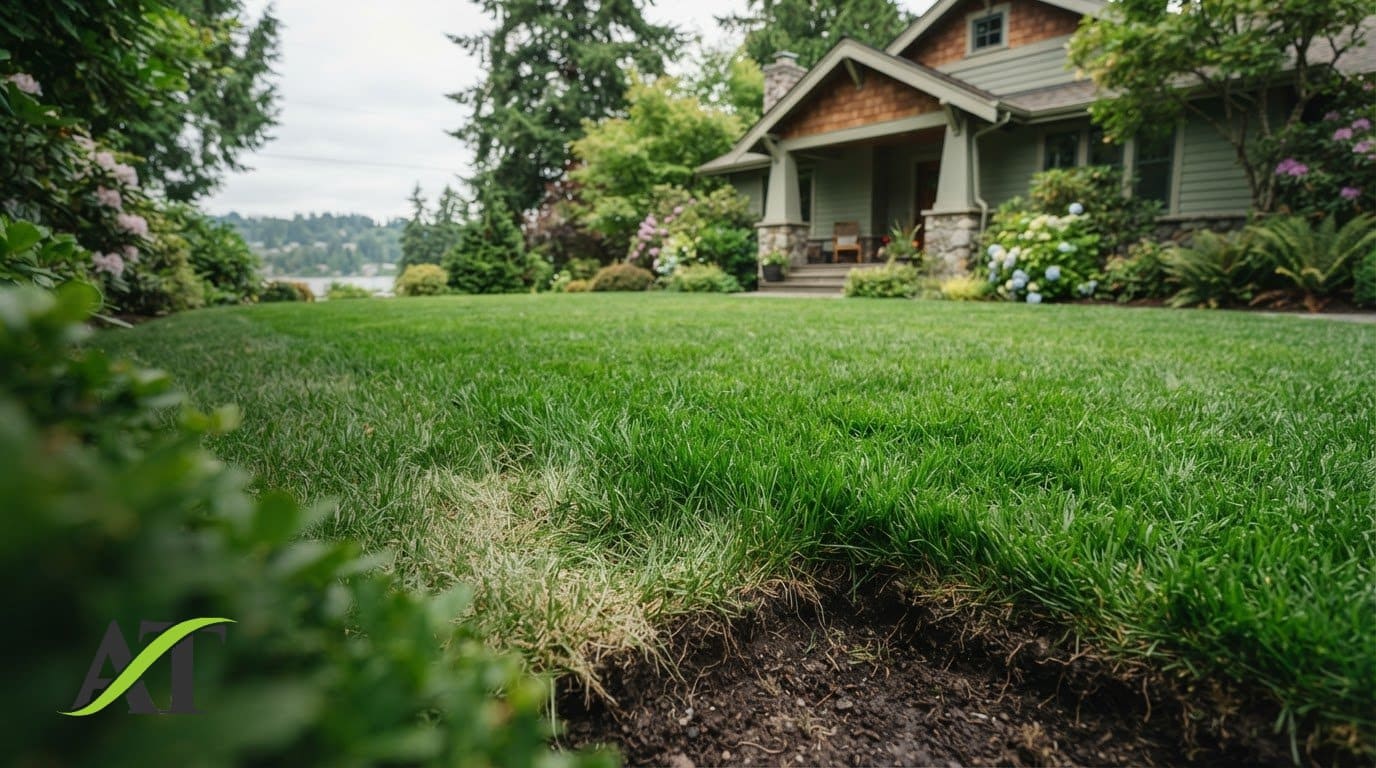
Start by assessing the lawn rather than assuming every property needs the same fall treatment. Look at grass density, compaction, moss, surface buildup, persistent bare areas and how well the lawn recovered from summer.
Assess First
Brown or stressed grass after summer is not automatically dead. Determine what actually remains thin, bare, compacted, mossy or covered with surface material.
Aerate When Compacted
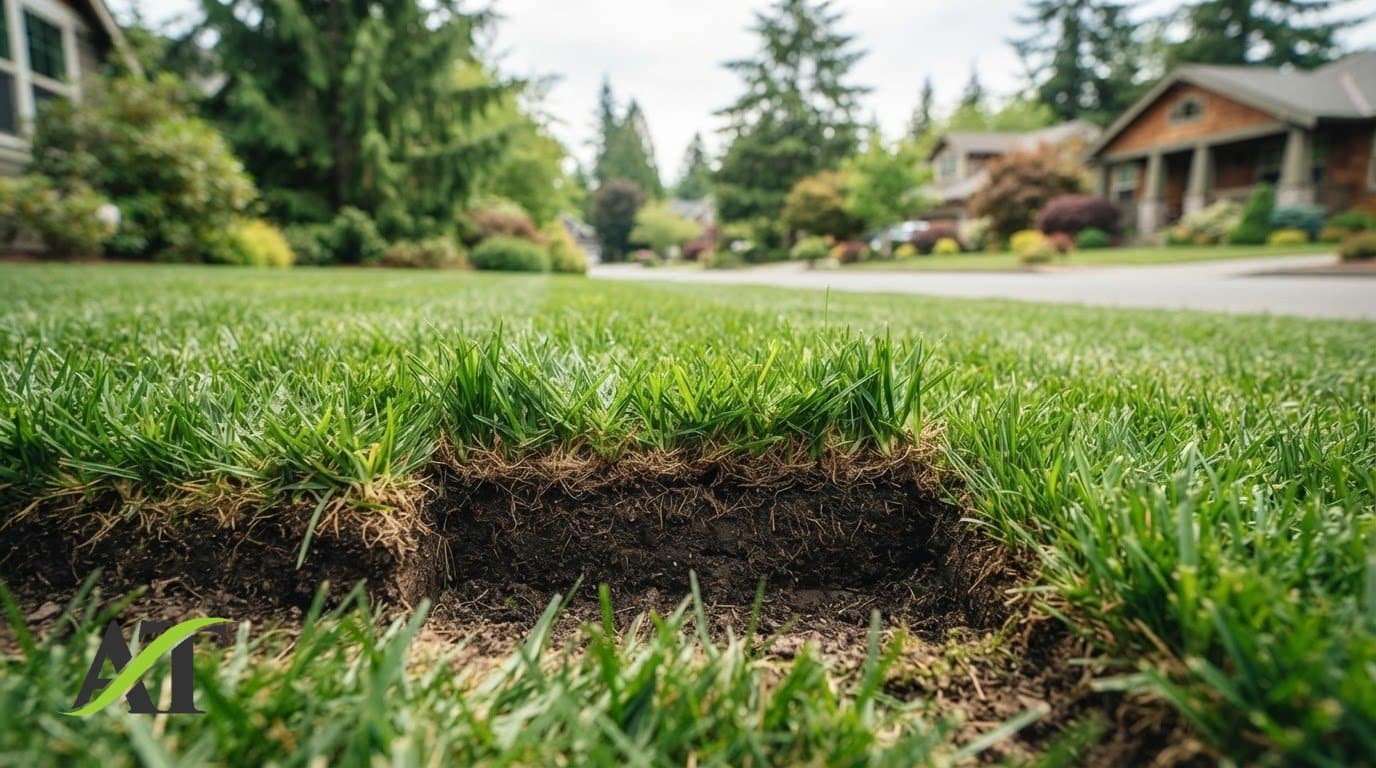
Core Aeration can relieve compacted lawn soil and create openings into the root zone. A reasonably dense lawn may not need a larger renovation.
Overseed When Density Is Low
If the lawn is thin, Premium Overseeding can help introduce new grass. Persistent bare areas may need the underlying cause addressed too.
Dethatch Only When Needed
Dethatching (Power Raking) is appropriate when moss, thatch or matted surface buildup actually needs to be removed. It is not an automatic fall step.
Assess → Improve → Establish → Add Only What the Lawn Needs
A Seattle fall lawn-care plan works better as a decision pathway than as a rigid checklist where every lawn receives every treatment.
Assess the Lawn
Look for hard or compacted soil, thin turf, recurring moss, heavy surface buildup and areas that remain bare even as cooler conditions return.
Relieve Compaction
When compaction is the primary issue, Core Aeration removes small plugs of soil and opens the root zone without automatically adding unnecessary services.
Rebuild Density
If the lawn is thin or tired, Premium Overseeding can add new grass. Starter fertilizer accompanies overseeding in Aerating Thatching Co.’s Lawn Tune-Up and renovation services.
Establish New Grass
Seed still depends on consistent moisture and proper after-care. Seattle rain can help, but it does not automatically replace attentive watering during establishment.
Add Surface Removal if Needed
If moss, thatch or matted material is covering the turf surface, Dethatching (Power Raking) may be appropriate before rebuilding.
Address Other Conditions Separately
Persistent shade, drainage, watering problems or repeated traffic may continue limiting the lawn even after fall renovation work is completed.
Relieve Compaction Without Automatically Overselling the Lawn
By the end of summer, repeated foot traffic, mowing and dry soil conditions can leave portions of a lawn hard or compacted. Core Aeration removes small plugs of soil to create physical openings into the root zone.
If the lawn is already reasonably dense and compaction is the main concern, Core Aeration alone may be enough. Overseeding and a larger renovation package are not automatically necessary.
Aeration does not fix everything
- It does not remove significant moss or thatch.
- It does not replace missing grass in a thin lawn.
- It does not correct major grading or drainage problems.
- It does not solve heavy shade.
- It does not make overseeding necessary when the lawn is already dense.
Use Fall to Rebuild Lawn Density Where Growing Conditions Support Grass
Fall can be a valuable overseeding period in the Seattle area because cooler conditions and returning moisture can support germination and establishment. The important part is giving seed enough favorable growing time before colder conditions substantially slow growth.
Premium Overseeding is especially useful when the existing lawn is still present but needs greater density. Building a denser lawn also leaves less open space for unwanted plants to establish, although overseeding itself is not a weed-control treatment.
Thin turf and persistent bare areas are not always the same problem
A generally thin lawn may respond well to overseeding. Large or repeatedly bare areas deserve a closer look at shade, drainage, irrigation, traffic or other site conditions before assuming that adding more seed is the entire solution.
Support New Seed During Establishment
Aerating Thatching Co.’s Lawn Tune-Up and Full Meal Deal Lawn Renovation include starter fertilizer with overseeding. Its role here is to support newly seeded grass during establishment rather than to imply that every existing Seattle lawn needs the same general fall fertilizer program.
An organic fertilizer upgrade is also available for applicable services when that option fits the homeowner’s preference and lawn plan.
Seed adds grass plants
Fertilizer can support growth, but it does not replace missing turf. When lawn density is the main issue, overseeding is the step that actually introduces new grass plants into the lawn.
Remove Moss, Thatch and Surface Buildup Only When Conditions Warrant It
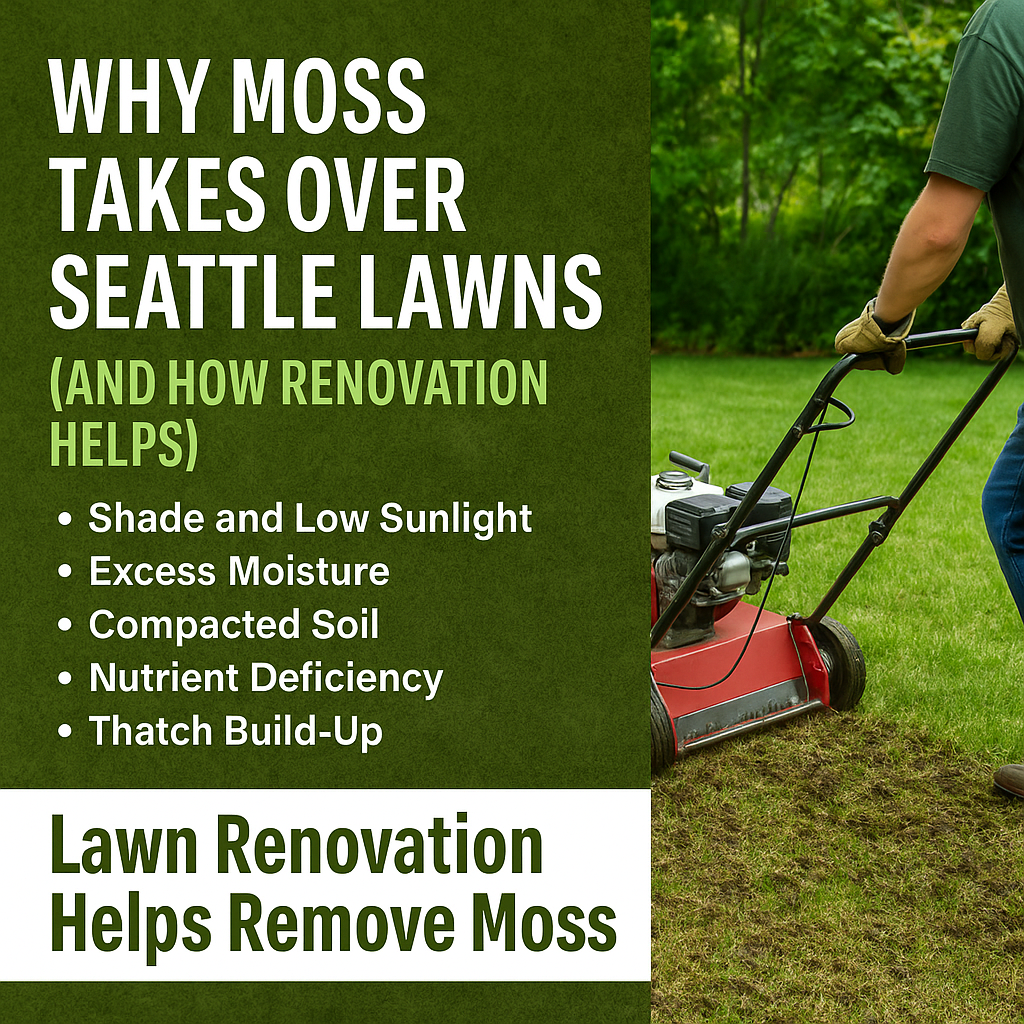
Dethatching (Power Raking) mechanically lifts accumulated material from the lawn surface. It can remove substantial existing moss, thatch and matted material when those conditions are actually present, but it should not be performed simply because the calendar says fall.
Moss and thatch are different
Thatch is an accumulated layer of living and dead plant material around the turf surface. Moss is a separate plant. Power raking can physically remove both types of surface material, but removing moss does not automatically correct why the moss developed.
Why moss may come back
Recurring moss can be associated with conditions such as shade, persistent moisture, compaction, thin grass or drainage limitations. Those conditions may still need attention after the visible moss has been removed.
Don’t Wait Too Late to Start an Overseeding Project
Conditions matter more than a hard cutoff date
Earlier fall generally gives new seed more opportunity to germinate and begin establishing while soil temperatures and growing conditions remain favorable. As the season advances and conditions become colder, establishment slows.
That does not mean there is one universal “last day” when overseeding suddenly stops working. Weather, soil temperature, moisture, sunlight, lawn condition and after-care all influence the result. The practical takeaway is simple: if fall overseeding is part of the plan, avoid treating late fall as interchangeable with earlier fall conditions.
Which Fall Lawn Service Fits Your Lawn?
The largest package is not automatically the best choice. Start with what the lawn actually needs.
Core Aeration
Best fit: a reasonably dense lawn where compaction relief is the primary concern.
- Core Aeration
- No automatic overseeding
- No automatic fertilizer
- No Dethatching (Power Raking)
Lawn Tune-Up
Best fit: a lawn that needs both compaction relief and greater grass density but does not need significant surface removal first.
- Core Aeration
- Premium Overseeding
- Starter Fertilizer
- Optional upgrades when appropriate
Full Meal Deal Lawn Renovation
Best fit: a lawn where moss, thatch or matted surface buildup also needs to be removed before rebuilding.
- Dethatching (Power Raking)
- Core Aeration
- Premium Overseeding
- Starter Fertilizer
Use Soil Improvements and Wetting Agents Only When the Lawn Needs Them
These options can support certain lawn conditions, but neither should be treated as a mandatory part of fall overseeding.
Soil Amendment Upgrade
A soil-amendment upgrade can support poor-structure or difficult soil as part of an eligible lawn service. It should not be presented as a cure for major drainage, grading, shade or irrigation problems.
Soil Wetting Agent
A wetting agent may be useful where soil resists normal water penetration or persistent dry areas remain difficult to hydrate evenly. It is not something every newly seeded lawn automatically needs.
What Fall Lawn Prep Won’t Fix by Itself
Aeration, overseeding and renovation can improve many lawns, but they cannot permanently overcome an unresolved site problem.
Fall Rain Doesn’t Replace Seed After-Care
Fall weather may reduce how much supplemental irrigation is needed, but newly seeded areas still depend on consistent moisture during establishment. Do not assume that occasional Seattle rain automatically keeps every seeded area evenly moist.
Protect newly seeded areas
- Follow the provided watering and mowing instructions.
- Adjust watering when rainfall provides enough moisture.
- Keep unnecessary foot, pet and equipment traffic off newly seeded areas.
- Avoid unnecessary traffic when the lawn and soil are very wet.
Manage fall leaves carefully
- Do not allow fallen leaves to continually cover newly seeded grass.
- Remove leaves gently enough that seed and young grass are not aggressively disturbed.
- Continue appropriate mowing while the lawn is actively growing.
Common Fall Lawn Prep Mistakes
New grass needs favorable growing conditions to germinate and begin establishing. Earlier fall generally gives it more opportunity than very late fall.
Rainfall can help, but new seed still needs consistent moisture. Check conditions rather than watering by assumption.
Dethatching (Power Raking) should solve an actual surface-buildup problem, not simply be performed because it is fall.
Removing existing moss does not automatically correct shade, compaction, persistent moisture or weak turf density.
Persistent bare areas may be telling you that shade, drainage, watering or another site condition remains unresolved.
Soil amendments, wetting agents and other options should be selected because they fit the lawn—not simply because they are available.
Can I Do Fall Lawn Prep Myself?
Yes. Homeowners can handle many basic fall tasks themselves, particularly mowing, leaf cleanup, watering, monitoring newly seeded areas and smaller-scale seeding or fertilizing projects.
Professional service becomes more practical when the job requires heavy equipment, broad coverage, significant surface removal or coordinating Core Aeration, overseeding and fertilizer across a larger lawn.
Professional help may make more sense when:
- The lawn is large or heavily compacted.
- Substantial moss or thatch needs mechanical removal.
- You are unsure whether the lawn needs aeration, overseeding or renovation.
- You want the work coordinated as one service visit.
Seattle Fall Lawn Prep Checklist
2004
Seattle-Area Lawn Experience, Owner on Every Job
Aerating Thatching Co. has been owner-operated since 2004. Stewart personally performs the lawn service, which means the person evaluating the lawn and recommending the level of work is also directly involved in performing it.
The goal is to recommend the service that fits the lawn rather than automatically moving every homeowner into the largest package.
Seattle Fall Lawn Prep FAQ
Is fall a good time to aerate a lawn in Seattle?
Fall can be a useful time for Core Aeration when the lawn is actively growing and soil conditions are suitable. Aeration is most appropriate when compaction is actually part of the lawn problem. If the lawn is already reasonably dense, Core Aeration alone may be enough; if it is also thin, adding overseeding may make more sense.
When is it too late to overseed a Seattle lawn?
There is no single universal cutoff date because weather, soil temperature, moisture, sunlight and lawn conditions vary. Earlier fall generally gives new grass more opportunity to germinate and begin establishing before colder conditions slow growth, so homeowners should avoid assuming very late fall is equivalent to earlier fall.
Does every lawn need Dethatching (Power Raking) in fall?
No. Dethatching (Power Raking) should be based on the lawn’s condition. If significant moss, thatch or matted surface material needs removal, it may be appropriate. If compaction or thin grass is the main issue and heavy surface buildup is not present, Core Aeration or a Lawn Tune-Up may be the better fit.
Should moss be removed before overseeding?
Where significant moss is covering the lawn surface, removing that material can be part of preparing the area for renovation and overseeding. However, moss removal does not automatically correct the shade, persistent moisture, compaction, weak turf density or other conditions that may have allowed moss to develop.
Do I still need to water new grass seed when it rains?
Yes, when rainfall is not providing enough consistent moisture. Fall rain can reduce the amount of supplemental irrigation needed, but newly seeded areas still need appropriate moisture during establishment. Adjust watering to actual conditions and follow the lawn after-care instructions rather than relying on the calendar or weather forecast alone.
Does my Seattle lawn automatically need lime in fall?
No. Lime should not be treated as an automatic annual fall treatment. It is a targeted soil treatment that makes sense when the lawn and soil conditions warrant it. Learn more in the Seattle lawn lime timing guide.
Not Sure What Your Lawn Needs? Ask Stewart.
You do not need to diagnose whether your lawn needs Core Aeration, a Lawn Tune-Up or the Full Meal Deal Lawn Renovation by yourself. Tell Stewart what you are seeing—compaction, thin grass, moss, bare areas or surface buildup—and he can help determine which level of work makes sense for the lawn.