Seattle Dry Lawn Buster + Soil Wetting Agent
When parts of your lawn seem impossible to keep evenly moist, simply watering longer is not always the answer. Our Dry Lawn Buster Soil Wetting Agent helps water penetrate and spread through difficult-to-wet soil more evenly—helping reduce stubborn dry spots, make better use of irrigation and support consistent moisture when new grass seed is establishing.
What Does a Soil Wetting Agent Do?
A soil wetting agent helps water enter and spread through difficult-to-wet soil more evenly. It is especially useful when certain areas remain stubbornly dry even though you are watering, when irrigation runs across the surface rather than soaking in well, or when you are trying to keep new grass seed consistently moist.
- Helps water penetrate dry or water-repelling soil
- Helps reduce localized dry spots and uneven moisture
- Helps irrigation and rainfall distribute more effectively
- Supports more consistent moisture during overseeding
- Can help reduce lawn stress during dry summer conditions
It does not replace watering, Core Aeration, drainage repair, sprinkler correction or lawn renovation when those are the real problems.
Signs Your Lawn May Be Difficult to Wet Evenly
Seattle-area lawns can go from months of wet weather to surprisingly dry summer conditions. As soil dries, some areas can become much harder to re-wet than others.
Dry Lawn Buster is most worth considering when the problem is not simply a lack of water, but how unevenly the soil is accepting that water.
- The same areas repeatedly dry out first
- Water seems to run across the lawn instead of soaking in
- Some areas remain dry while nearby areas stay moist
- The lawn develops persistent localized dry patches
- You are overseeding and want moisture distributed more consistently
- You are preparing the lawn for a drier stretch of weather
What Dry Lawn Buster Helps Improve
This is not a “make the lawn green” treatment by itself. Its job is to improve water behavior in the soil, which can support several important lawn-care goals at once.
Better Soak-In
Helps water move into difficult-to-wet soil instead of immediately traveling across the surface.
Fewer Dry Pockets
Helps create more uniform moisture instead of having one part of the lawn wet while another remains dry.
Less Summer Stress
Better moisture distribution can help the lawn make more effective use of watering during dry weather.
Seed Watering Support
Helps irrigation reach overseeded areas more consistently when maintaining surface moisture is especially important.
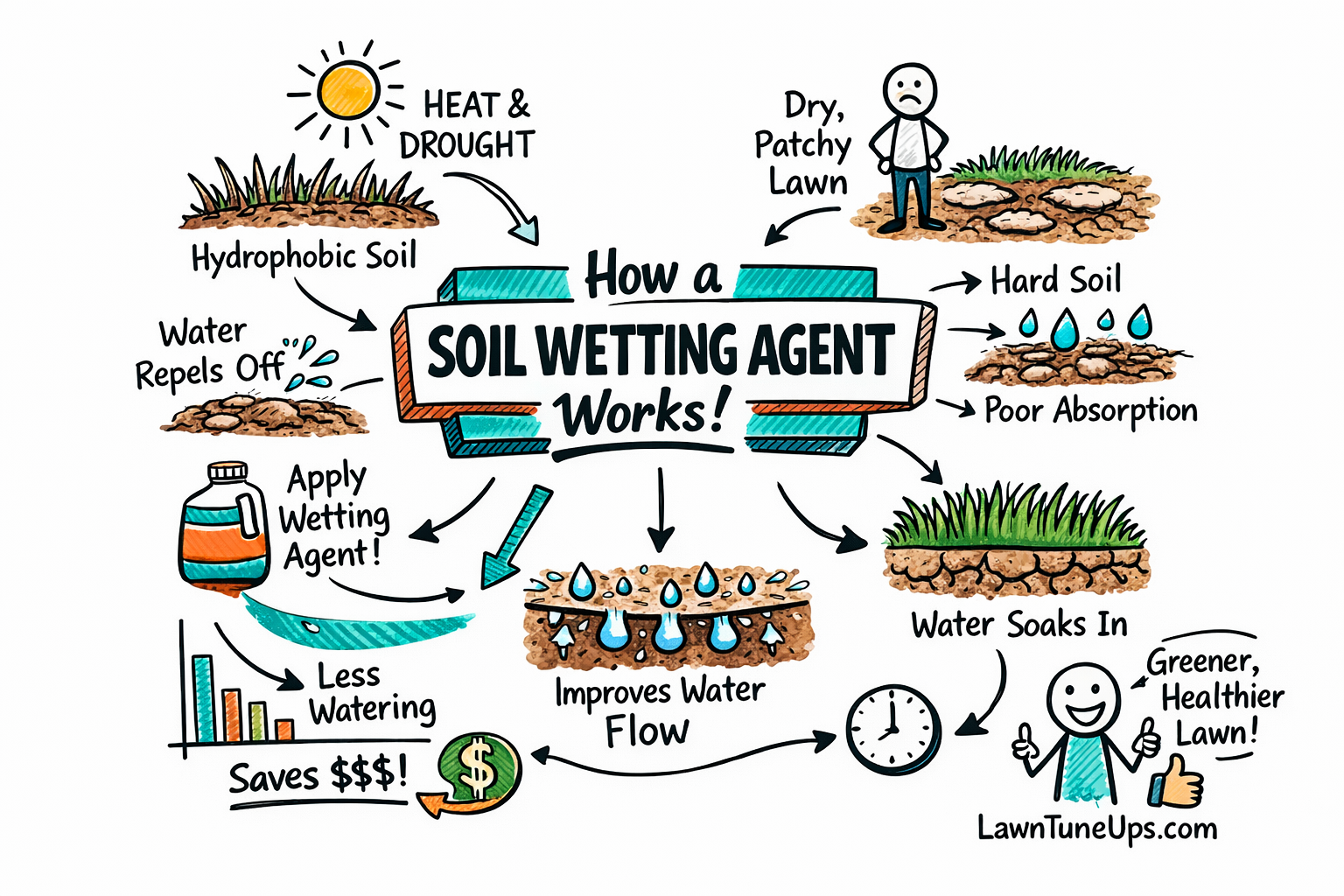
How a Soil Wetting Agent Works
Water does not always spread evenly through dry soil. Some areas accept moisture easily while others become difficult to re-wet. A wetting agent changes how water interacts with the soil so it can spread more uniformly.
Water Reaches the Lawn
Rainfall or irrigation lands on the surface, but dry or water-repelling areas may not accept it evenly.
The Wetting Agent Helps
The treatment helps reduce the tendency for water to bead, channel or bypass difficult-to-wet portions of the soil.
Moisture Spreads More Evenly
With continued watering, moisture can move through treated soil more uniformly instead of leaving the same dry pockets behind.
Important: a wetting agent helps water behave better in the soil. It does not create water. The lawn still needs appropriate rainfall or irrigation.
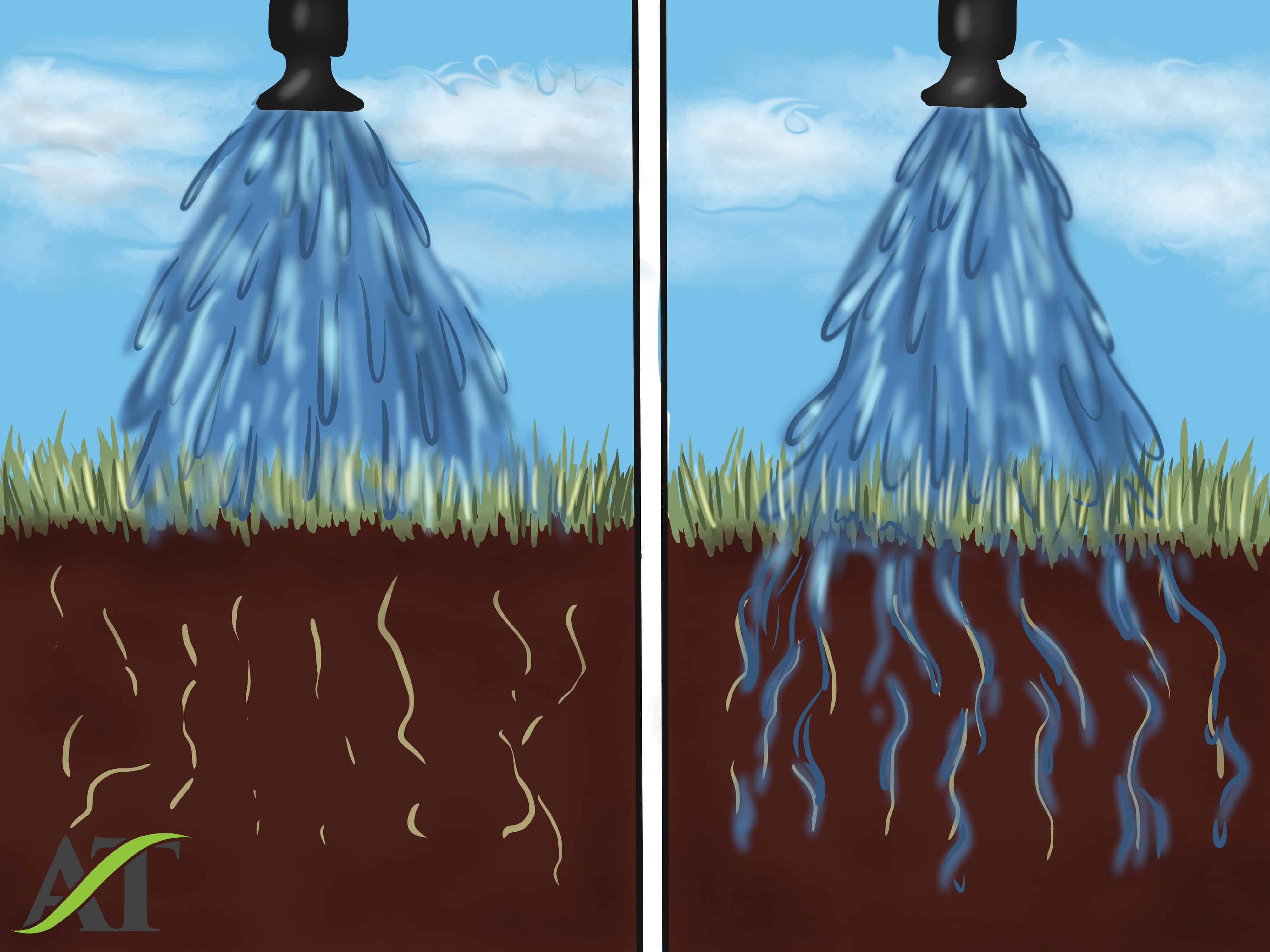
Visual Explanation of Water Movement
These visuals help show why two areas receiving similar amounts of water can behave very differently.
What Dry Lawn Buster Does—and What It Does Not Fix
Wetting agents can be very useful when water-repellent or unevenly wetting soil is the problem. But not every brown spot, runoff problem or struggling lawn is caused by that.
It Can Help With
- Persistent localized dry areas
- Soil that is difficult to re-wet after drying
- Uneven water penetration
- Surface runoff related to poor soil wetting
- More uniform moisture during overseeding
- Water-management support during dry weather
It Does Not Replace
- Core Aeration when severe compaction is limiting the lawn
- Correction of heavy clay or hardpan problems by itself
- Repair of poor grading or true drainage problems
- Correction of broken or poorly designed irrigation
- Overseeding or renovation where grass is already dead
- Adequate ongoing lawn watering
Not sure which problem you have? Tell Stewart what you are seeing when you request a quote. The goal is to recommend the lawn work that actually fits the condition—not automatically add every available upgrade.
Why Wetting Agent and Overseeding Work Well Together
Newly seeded areas need dependable moisture during germination and early establishment. That becomes more challenging when one part of the soil accepts water readily while another repeatedly dries out.
Dry Lawn Buster can help irrigation distribute through the treated soil more evenly, making it a useful upgrade when overseeding during drier conditions.
It does not reduce the need to water new seed carefully and consistently. Think of it as helping the water you apply reach the soil more uniformly.
Good Reasons to Add It With Seed
- Some parts of the lawn repeatedly dry faster than others
- Summer or early-fall conditions are becoming dry
- The lawn has a history of stubborn dry spots
- You want more consistent moisture across overseeded areas
Where Dry Lawn Buster Fits With Our Core Services
Dry Lawn Buster is offered as an add-on to our core services. The best pairing depends on what else is limiting the lawn.
Core Aeration
Core Aeration physically removes plugs from compacted soil. The wetting agent addresses how water spreads through the treated soil. They solve different problems and can complement each other.
Learn About Core Aeration →Lawn Tune-Up
The Lawn Tune-Up combines Core Aeration, Premium Overseeding and Starter Fertilizer. Adding Dry Lawn Buster can be especially useful when new seed also needs more uniform moisture.
See the Lawn Tune-Up →Full Meal Deal
When a lawn also has heavy thatch, matting, moss buildup or weak existing turf, the Full Meal Deal provides the stronger renovation approach and Dry Lawn Buster can be added when water distribution is also a concern.
See the Full Meal Deal →What if the underlying soil needs more help?
A wetting agent improves water movement, but some weak lawn areas need broader soil improvement. If soil condition itself appears to be limiting recovery, Stewart may recommend a soil-focused upgrade instead of—or in addition to—the wetting agent.
See a Wetting Agent Used as Part of Lawn Improvement
Wetting agent treatments are often most valuable as one part of a broader lawn-improvement plan rather than as a stand-alone cure for every dry or struggling lawn.
When Is the Best Time to Use Dry Lawn Buster?
The treatment is most useful when uneven soil moisture is becoming a problem—or before a known dry period when better water distribution will matter.
A useful time to improve how the soil accepts water before prolonged dry weather makes stubborn dry areas more obvious.
Especially useful when establishing new grass during weather that requires regular irrigation and careful moisture management.
Existing localized dry areas can be a strong sign that some soil zones are not re-wetting as effectively as the rest of the lawn.
Watering After Application
The treatment needs water to help move it from the grass surface into the soil. Continue following the watering instructions appropriate for your lawn and any companion service.
If the lawn has been overseeded, careful watering remains especially important. The wetting agent can help improve moisture distribution, but it does not replace the frequent watering needed to establish new grass.
Rain can contribute to watering the application into the soil, but light rainfall may not supply enough moisture by itself.
Approximately 4–6 Weeks Per Application
A typical Dry Lawn Buster application provides wetting-agent benefits for approximately 4 to 6 weeks.
Actual performance can vary with soil conditions, weather, irrigation and how quickly the lawn dries during hot weather.
It is a temporary water-management treatment rather than a permanent change to the soil.
Can I Use the Lawn Right Away?
Yes. The lawn is safe to access immediately after the application.
Continue following any separate after-care instructions that apply to Core Aeration, overseeding or another service performed at the same time.
Dry Lawn Buster Soil Wetting Agent: $90 Add-On
The Soil Wetting Agent is currently offered as a $90 upgrade to a core lawn service.
It is particularly worth discussing when your lawn has persistent dry areas, water is not soaking in evenly, or you are overseeding during drier conditions.
Not every lawn needs it. If the lawn's real problem is compaction, drainage, failing irrigation or dead turf, Stewart may recommend addressing that problem instead.
Seattle Soil Wetting Agent FAQ
What is Dry Lawn Buster?
Dry Lawn Buster is our soil wetting agent treatment. It helps water penetrate and spread through difficult-to-wet soil more evenly, making it useful for localized dry spots, uneven moisture and water-management support during overseeding.
How long does a lawn wetting agent typically last?
A typical application lasts approximately 4 to 6 weeks. Actual performance can vary with soil conditions, weather, irrigation and how quickly the lawn dries during hot weather.
Is the lawn safe to use after the application?
Yes. The lawn is safe to access immediately after the application. If another service such as overseeding was performed at the same time, continue following the after-care instructions for that service.
Do I need to water after the wetting agent is applied?
Yes. Water helps move the treatment from the grass surface into the soil, where it can improve moisture movement. Continue following the watering instructions provided for your lawn and any companion service.
What if it rains after the application?
Rain can help water the treatment into the soil. Light rainfall may not provide enough moisture by itself, so continue normal irrigation when needed rather than assuming a small amount of rain completed the watering.
Does a wetting agent replace regular lawn watering?
No. A wetting agent helps water spread and soak into soil more evenly, but it does not create water or replace irrigation. Your lawn still needs enough moisture for the weather, soil conditions and grass.
Will it reduce runoff and puddling?
It can help when runoff is related to soil that is difficult to wet. However, runoff or puddling can also be caused by compaction, slopes, excessive sprinkler output, poor grading, drainage problems or applying too much water at one time. A wetting agent does not correct those other causes by itself.
Can it help with localized dry spots?
Yes. Persistent localized dry spots are one of the main reasons to consider a soil wetting agent, particularly when certain areas repeatedly resist moisture while nearby soil wets normally.
How quickly will I notice a difference?
The treatment begins helping as it is watered into the soil. Changes in how evenly the soil accepts moisture may appear quickly. Visible recovery of stressed grass can take longer and depends on the severity of the damage, weather, watering and root health.
When is the best time to apply a lawn wetting agent?
It is most useful before or during periods when soil is drying unevenly, irrigation is not soaking in well, localized dry spots are appearing, or newly seeded areas need particularly consistent moisture. It can also be useful before prolonged summer dryness.
Can a wetting agent be combined with Core Aeration?
Yes. Core Aeration and a wetting agent address different issues. Core Aeration physically removes plugs to relieve compaction, while the wetting agent helps water spread through treated soil more uniformly. Combining them can make sense when both compaction and uneven water penetration are present.
Can it be added to a Lawn Tune-Up?
Yes. This is one of the most natural pairings. A Lawn Tune-Up combines Core Aeration, Premium Overseeding and Starter Fertilizer. Adding Dry Lawn Buster can help the soil accept water more evenly while new seed is being kept consistently moist.
Can it be added to a Full Meal Deal?
Yes. Dry Lawn Buster can be added to a Full Meal Deal Lawn Renovation when the lawn needs Dethatching (Power Raking), Core Aeration, Premium Overseeding and Starter Fertilizer and uneven water penetration is also a concern.
Is a wetting agent helpful when overseeding?
Yes. New grass seed needs consistent moisture. A wetting agent can help irrigation spread through treated soil more evenly and reduce stubborn dry pockets. It does not replace the frequent, careful watering required during germination and early establishment.
Is a wetting agent the same as Core Aeration?
No. Core Aeration physically removes plugs from the lawn to relieve soil compaction. A wetting agent changes how water interacts with the soil so moisture can spread more uniformly. The two address different problems.
Will it fix heavy clay or severely compacted soil?
Not by itself. A wetting agent can improve water movement, but it does not physically relieve severe compaction or change heavy clay into a different soil. Core Aeration or broader soil-improvement work may be more appropriate when those conditions are the main limitation.
Will it fix a drainage problem?
No. A wetting agent can help difficult-to-wet soil accept moisture more evenly, but it does not correct poor grading, standing-water drainage problems, broken irrigation, excessive sprinkler output or other physical drainage issues.
Will Dry Lawn Buster bring dead grass back to life?
No. It can help stressed grass by improving moisture distribution when water penetration is part of the problem, but dead turf must be repaired or replaced with new growth. A Lawn Tune-Up or Full Meal Deal may make more sense when the lawn needs overseeding or broader renovation.
Will one application permanently fix water-repellent soil?
No. One application generally provides wetting-agent benefits for approximately 4 to 6 weeks rather than permanently changing the soil. Recurring dry spots may also require better irrigation practices, Core Aeration or other soil-focused improvements.
How much does Dry Lawn Buster cost?
The current Soil Wetting Agent / Dry Lawn Buster price is $90 as an add-on to a core lawn service. You can review current service pricing on our pricing page or include the wetting agent when requesting your quote.
How do I know whether my lawn actually needs it?
It is most worth considering when the same lawn areas repeatedly stay dry, water runs across the surface rather than soaking in well, moisture is noticeably uneven, or you are overseeding during drier conditions. If you are unsure, describe what you are seeing when requesting your quote so Stewart can recommend the most appropriate approach.
Ask Stewart About Your Lawn
You do not need to diagnose water-repellent soil yourself. Tell Stewart what you are seeing—persistent dry areas, runoff, uneven watering, thin grass or an upcoming overseeding project.
Dry Lawn Buster is an optional upgrade, not something every lawn automatically needs. The goal is to add it when it solves a real water-management problem.